


We take it for granted that we have a right to time off. Whether it’s Bank Holidays or a week away in the sun. But it wasn’t always like this… Come with us for a little foray into the history of seaside holidays.
The British seaside holiday weekend is an institution as old as the hills. The Bank Holiday Monday dates back to the Bank Holidays Act of 1871.
Did you know? Incredibly, the idea of a ‘Bank Holiday’ was dreamt up by the MP for Maidstone – because he wanted to give bank workers a chance to watch a day’s cricket!
Popular as it is, the majority of holiday makers today would probably spend their bank holidays doing lots of other things as well as watching cricket. One thing is for sure, that we all certainly enjoy time off from the daily grind.
Did you know? That the ‘daily grind’ dates back to times when we all had to monotonously grind enough grain to make our own bread for that day?
In the UK, it was the Holidays with Pay Act 1938 which gave workers the right to one week’s holiday a year. And that was just the ones whose minimum rates of wages were fixed by trade boards. It was the first law on paid leave in this country. But trade unions had demanded two weeks – and the law still didn’t cover all workers.
That’s how we got ‘Wakes Weeks’ where all the employers of an area would close for one or two weeks holiday. All the employees would descend on the seaside en-masse. Wakes holidays started as unpaid leave in the days when the mills and factories closed for maintenance.
Wakes Week
So why’s it called Wakes Week? Church services began at sunset on Saturday and the night of prayer was called a vigil, eve or, due to the late hour “wake”, from the Old English word waecan. Each village had a wake with quasi-religious celebrations such as rushbearing followed by church services then sports, games, dancing and drinking. As wakes became more secular the more boisterous entertainments were moved from the sabbath to Saturday and Monday was reserved for public entertainments such as bands, games and funfairs.

During the Industrial Revolution the tradition of the wakes was adapted into a regular summer holiday. Especially so in the North of England and industrialised areas of the Midlands. Each locality had a different wakes week when the local factories, collieries and industries closed for a week.
Even as late as the 1960’s, time off work was still in short supply. Many people had the Bank Holidays plus a fortnight in summer.
Since 1 April 2009, almost all workers have been legally entitled to 5.6 weeks’ paid holiday a year. It’s known as statutory leave entitlement or annual leave. And here’s a video filmed in your favourite destination!
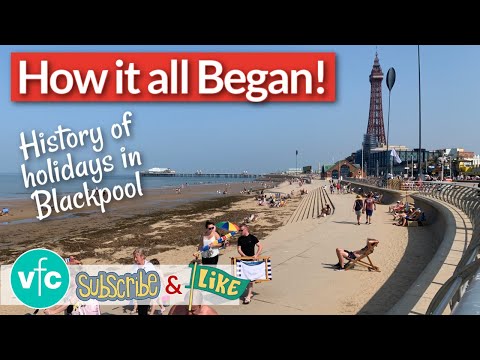
History of Seaside Holidays
Seemingly, it was a woman called Elizabeth Farrow who proclaimed the benefits of the seaside waters when she’d been to South Bay at Scarborough. Way back in 1626 she started the craze for ‘Taking the Waters’ at spa resorts all over the UK.
The Scarborough water was claimed to be a remedy for ‘Hypochondriack, Melancholy and Windness’. It could cure epilepsy, apoplexy, vertigo, catalepsy, cleanse the stomach and put an end to scurvy, asthma and black and yellow jaundice!
Maybe we ought to dash out and bottle Fylde Coast sea water. We’d make a fortune if it’s so effective ? If it weren’t for the health and safety police and the bacteria in the water of course!!
Looking for somewhere to stay?
Book your stay with the Visit Fylde Coast accommodation guide and know that you’ll have a great place to stay.
Bookings via Visit Fylde Coast are zero commission. This means that more of the money from your booking helps to support the local economy.
[sv_search_form]
Bathing Machines and Beach Huts
You probably enjoy a paddle, jaunting about in skimpy shorts and flashing the flesh at your choice of Blackpool, Fleetwood or Cleveleys (assuming of course that it’s hot enough). But next time you’re enjoying the weather, spare a thought for the early holiday making women who had to swim just about fully clothed. That was after first being carted into the water in an old fashioned bathing machine.

Beach huts are a descendant of these bathing machines. The first one was built in Bournemouth in 1909 and now even has its own blue plaque.
There are 20,000 of them around the coast of the UK. We’ve got beach huts at St Annes, and older pastel painted ones tucked right against the sands at Fleetwood. Plus modern ones built into the Marine Hall Colonnades. Cleveleys did have beach huts once, but they were removed when the sea wall was rebuilt. If only you could guarantee the weather, what better way could there be to spend an idyllic holiday than sitting in the sun in your seafront shed.

Going further back to the 50’s and 60’s you might even remember the bathing station on Cleveleys beach.

Crunch the sand in your sandwiches, and while away the sunny days to finish with warm evenings and one of our speciality sunsets. It’s the stuff that memories are made of on cold, damp winter nights.
Arrival of the Railways
It’s well documented that the arrival of the railways was the thing that really made the Fylde Coast and Blackpool great.
There’s a corridor from the end of the M55 to the seafront, past Blackpool Football Club to Central Car Park. That tract of land was once the site of the enormous railway lines and platforms for Blackpool Central Station. They brought many thousands of passengers to Blackpool in its heyday.

Now it’s where strangers park when they don’t know their way around town. They arrive at the end of the motorway – full of anticipation of a great time ahead. We’ve all done it. Plans are underway for the new Blackpool Central leisure destination – making it great again for the future.
Feel the cool sunshine early in the day when you park your car and the world is just starting to come to life. It gives way to the sun high in the sky and (hopefully) the heat of the day, together with lots of new memories. Amusements, candy floss, donkey rides, shopping and attractions are saved for a later day or year, when the weather, or maybe your life, is cold and grey.
A History of Anticipation
But more than anything, there’s a sense of anticipation that comes with a holiday. Going right back through the history of seaside holidays it’s always been a way to turn off the real world and your worries.
Whether now or back then, people have always eagerly anticipated their holiday. Planned what to do, what to pack and where to go.
Does it really matter if it rains and the weather is bad? Not really, especially on this coast and particularly in Blackpool. There’s always something to do that doesn’t rely on the weather. After all, the place has a reputation for being somewhere to go when it’s wet!
Waxing and Waning of Seaside Holidays
In its heyday, you could hardly put a pin down in Blackpool for the crowds. It was always incredibly popular, for many, many years.

Then the jumbo jet and package holiday arrived in the late 70’s and 80’s. British holiday makers really liked the idea of pretty much guaranteed sunshine, en-suite bathrooms and buffet breakfasts. People went abroad in their droves and seaside towns like Blackpool suffered, all around the UK.
As the world’s got smaller, people got used to the idea of jetting off to Europe for weekend breaks abroad. Once upon a time they’d have thought no further than the local park and an egg sandwich.
But the Fylde Coast is fighting back! Huge amounts of regeneration work have been carried out and much more is underway. New hotels are being built, public facilities improved, new attractions developed.
The arrival of the Staycation
Increasing numbers of people were already choosing to holiday in the UK, for many different reasons. Some choose to reduce their carbon footprint, others to support the UK economy. Some just can’t tolerate the stress of travelling and airports.
Then, just after this article was first written in January 2020, the Covid-19 pandemic came along. And with it the resurgence of the British seaside holiday and arrival of the Staycation! In 2022 as the world emerged from the effects of two years of the pandemic, war breaks out in the Ukraine. The cost of living soars, people have less money and fuel is more expensive.
It feels like everything is changing. How we spend money certainly is. Now, people are enjoying a break here in the UK, flocking back to Blackpool in their tens of thousands. The resort responds with investment in new hotels, attractions and public facilities. There’s a fantastic events calendar right through the year. What a great time to enjoy the Great British Coast!

Whatever the reasons, the Fylde Coast is as popular as ever and ready for another chapter in the history of seaside holidays!
Seaside Traditions
We’ve been enjoying our holidays at the coast for a few hundred years now. But some things always endure the passage of time. They’re the traditions that our ancestors enjoyed, and we always want to pass them onto the next generation!
Donkey rides
It’s believed that donkey rides first began in Blackpool in around 1890. They were probably working animals used in the fishing industry – whose owners spotted their potential!

Even though the world is so much more modern, donkey rides are still a favourite with todays tech-obsessed children. You’ll find them on most popular UK seaside beaches, including of course Blackpool and St Annes.
Find out more about seaside donkeys here
Seaside postcards
We’ve all done it, sent a postcard back home when we’ve been away on holiday. These little rectangles of card proclaim a good-time had by all – and make those on the receiving end wish they were there!

When you’re browsing the selection in the gift shops, you might be surprised to know that they date back to 1894. That was when Royal Mail gave publishers permission to send them through the post.
Fashions have changed over the years – from the saucy cartoons of Donald McGill to glossy wide-angle views. But we still enjoy sending and receiving them!
Much more about seaside postcards here
Other pages you might be interested in
- 20 reasons to holiday in the Blackpool area
- Holiday flats in the 1970’s – Chrissie Blogger
- My summer holidays in Blackpool – Chrissie Blogger
While you’re here…
Go to the homepage of the Visit Fylde Coast website for the latest updates.
Love the Fylde Coast? Sign up for your email newsletter. Packed full of interesting things it arrives in your inbox all 52 weeks of the year.
👉Join us on Facebook at our Visit Fylde Coast Facebook Group. Plus hundreds of videos to watch on our YouTube channel – from all over the Fylde Coast!
📣JOIN our new VFC WhatsApp Channel for what’s happening, interesting local information, history, communities, events and much more.
Booking a stay? Pick a safe, clean and legal place to stay, at the very best price. Book using the Visit Fylde Coast Accommodation guide.


