


Visit Fylde Coast thought we’d record this exceptional (but not in a good way) health situation. It’s history in the making. So welcome to the Coronavirus Diaries.
People still talk about the Spanish Flu pandemic which happened exactly 100 years ago. It raged from January 1918 to December 1920 and infected 500 million people – about a quarter of the world’s population. That world-wide infectious disease killed 50,000,000 people.
This is also history in the making. People will look back on this and talk about it for many years to come. So this is our view of matters as they unfold in this corner of the world.
What is Covid-19?
The infectious disease which is currently sweeping the world has been named Covid-19. The most recently discovered coronavirus, it was previously unknown before the outbreak began in Wuhan, China, in December 2019.
Coronaviruses are a large family of viruses which may cause illness in animals or humans. A number of them cause respiratory infections in humans. These range from the common cold to more severe diseases such as Middle East Respiratory Syndrome (MERS) and Severe Acute Respiratory Syndrome (SARS).
Official Sources of Information/Guidance
- Official guidance on all things Covid-19 from the gov.uk website
- Get all of the latest health advice from the NHS website.
On this page the most recent updates appear at the top. Scroll to the bottom to see where the pandemic began.
Coronavirus Diaries – November 2021
Apologies, we’ve slipped off the regular updates to this page. Summer 2021 has been and gone in a relatively normal fashion here in the UK. We’ve had our jabs and boosters and been reasonably careful. Infection rates have remained reasonably high but the vaccination programme has greatly reduced the numbers of people needing hospitalisation.
Covid is now part of everyday life and it’s our ‘new normal’. So much so that we’re all looking forward to a better Christmas this year, with family and celebrations.
Then the news that we were all dreading. Another variant of concern – and here we go again.
The new Omicron Variant
23 November 2021 – UK scientists first become aware of a new strain after samples are uploaded on to a coronavirus variant tracking website from South Africa, Hong Kong and then Botswana.
26 November 2021 – Six southern African countries – South Africa, Namibia, Lesotho, Eswatini, Zimbabwe and Botswana – are added to the travel red list, meaning flights are suspended.
The virus is described as ‘very serious’, with concerns about how effective the vaccines will be in preventing it. On 26th the World Health Organisation declare it a variant of concern and name it Omicron – the fifteenth letter of the Greek alphabet – or ‘O’ to you and me.
27 November 2021 – two cases are discovered here in the UK. One in Brentwood and one in Nottingham. The UK is the second country to have detected it, after Belgium reported a single case on Friday.
Face masks are once again compulsory in some indoor settings and on public transport after Boris Johnson set out new measures at a press conference on 27 November. He said “We need to make sure that the vaccines are boosted because very high levels of antibody coverage will create a higher proportion of people protected even against a variant.
“We don’t yet exactly know how effective our vaccines will be against Omicron but we have good reasons for believing they will provide at least some measure of protection.
“If you’re boosted, your response is likely to be stronger so it’s more vital than ever that people get their jabs and as fast as possible. We’re going to boost the booster campaign, we’re already planning to do six million jabs in England alone over the next three weeks and now we’re looking to go further.”
Please. Get your jabs. Wear a mask.
Coronavirus Diaries – March 2021
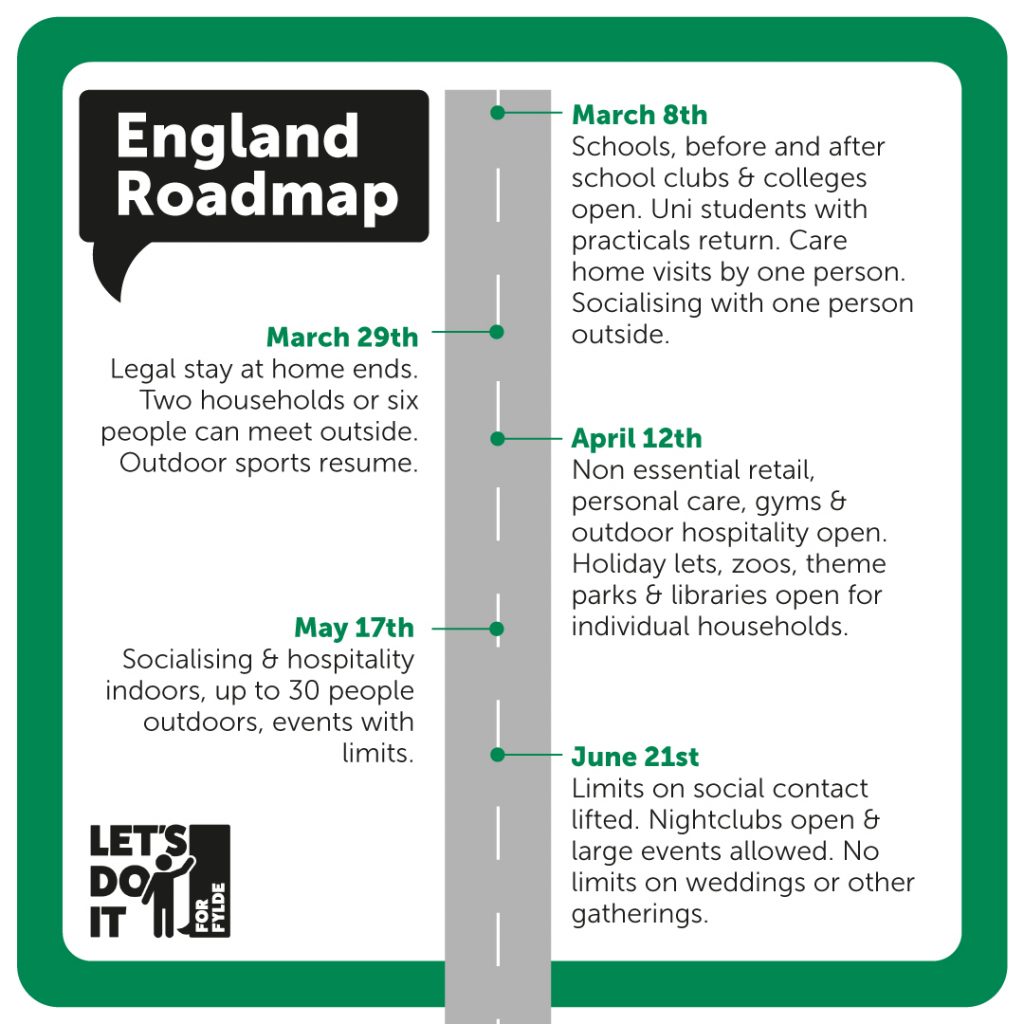
Step 1 – from 8 March 2021
Return to education.
Businesses permitted to open are the same as already allowed – ie those deemed to be ‘essential’.
Socialising with one person outside.
Care home visits can be made by one person.
from 29 March 2021
Legal stay at home ends.
Two households or six people can meet outside.
Outdoor sports resume.
People can use the following venues in a group of six people, or with members of up to two households:
- Outdoor sport facilities. Gyms, swimming pools, sports courts (such as tennis and basketball courts), golf courses, including mini golf, water sports venues, climbing walls, driving and shooting ranges, riding arenas at riding centres, archery venues.
Next Steps, subject to review of the data:
Step 2 – from 12 April at the earliest, subject to an assessment of the data against the four tests
Outdoor gatherings must still be limited to 6 people or 2 households as in Step 1, and no indoor mixing will be allowed unless otherwise exempt. Additional premises will be able to reopen but should only be visited alone or with household groups:
- Non-essential retail
- Personal care premises such as hairdressers, salons and close contact services
- Indoor leisure facilities such as gyms and spas (but not including saunas and steam rooms, which are due to open at Step 3).
- Public buildings such as libraries and community centres
- Hospitality venues for outdoor service, without any curfew or the requirement for alcohol to be accompanied by a substantial meal – customers must order, eat and drink while seated.
- Most outdoor settings and attractions including outdoor hospitality, zoos, theme parks, drive-in cinemas/performances/events will reopen
In addition:
- Domestic overnight stays will be allowed and self-contained accommodation – those that do not require shared use of bathing, entry/exit, catering or sleeping facilities – can also reopen, though must only be used by members of the same household.
- Weddings, receptions, and commemorative events including wakes will be able to take place with up to 15 attendees (in premises that are permitted to open).
- International holidays will not be permitted.
All newly open settings must abide by the social contact rules. This will be accompanied by mitigations including workforce testing and continued social distancing guidance. People should continue to work from home where they can and minimise domestic travel where they can. International holidays will still be prohibited.
Step 3 – from 17 May at the earliest and at least five weeks after Step 2
Most legal restrictions on meeting others outdoors will be lifted, but gatherings of more than 30 people outdoors will remain illegal. Indoors, people will be able to meet socially in a group of 6, or with 1 other household (though it may be possible to go further than this at Step 3 depending on the data). COVID-Secure guidance will remain in place and premises must not cater for groups larger than the legal limits.
Sectors which will reopen include:
- Indoor hospitality, with no requirement for a substantial meal to be served alongside alcoholic drinks, and no curfew. The requirement to order, eat and drink while seated (‘table service’) will remain;
- Remaining outdoor entertainment, such as outdoor theatres and cinemas;
- Indoor entertainment, such as museums, cinemas and children’s play areas;
- Remaining accommodation, such as hotels, hostels and B&Bs;
- Adult indoor group sports and exercise classes; and
- Some large events, including conferences, theatre and concert performances and sports events.
- Controlled indoor events of up to 1,000 people or 50% of a venue’s capacity, whichever is lower, will be permitted, as will outdoor events with a capacity of either 50% or 4,000 people, whichever is lower.
- The Government will also make a special provision for large, outdoor, seated venues where crowds can be safely distributed, allowing up to 10,000 people or 25% of total seated capacity, whichever is lower.
- In addition, pilots will run as part of the Events Research Programme to examine how such events can take place without the need for social distancing using other mitigations such as testing.
In addition:
- Weddings, receptions, funerals, and commemorative events including wakes can proceed with up to 30 attendees.
- A broader range of stand-alone life events will also be permitted at this step, including bar mitzvahs and christenings.
Step 4 – from 21 June at the earliest, and at least five weeks after Step 3
With appropriate mitigations in place, by Step 4, the Government aims to remove all legal limits on social contact. Reopen the remaining closed settings, including nightclubs and enable large events, including theatre performances, above the Step 3 capacity restrictions (subject to the outcome of the scientific Events Research Programme) and remove all limits on weddings and other life events, subject to the outcome of the scientific Events Research Programme.
Coronavirus Diaries – February 2021
By 15 February 2021, the government’s target of offering vaccines to everyone in the top four priority groups has been met. In a huge, sterling effort, more than 15 million vaccines have been given since 8 December 2020. Well done to everyone who is involved.
On 22 February 2021, Prime Minister Boris Johnson set out the UK’s new roadmap out of lockdown.
Coronavirus Diaries – January 2021
And so a new year begins, and so does another wave of infection.
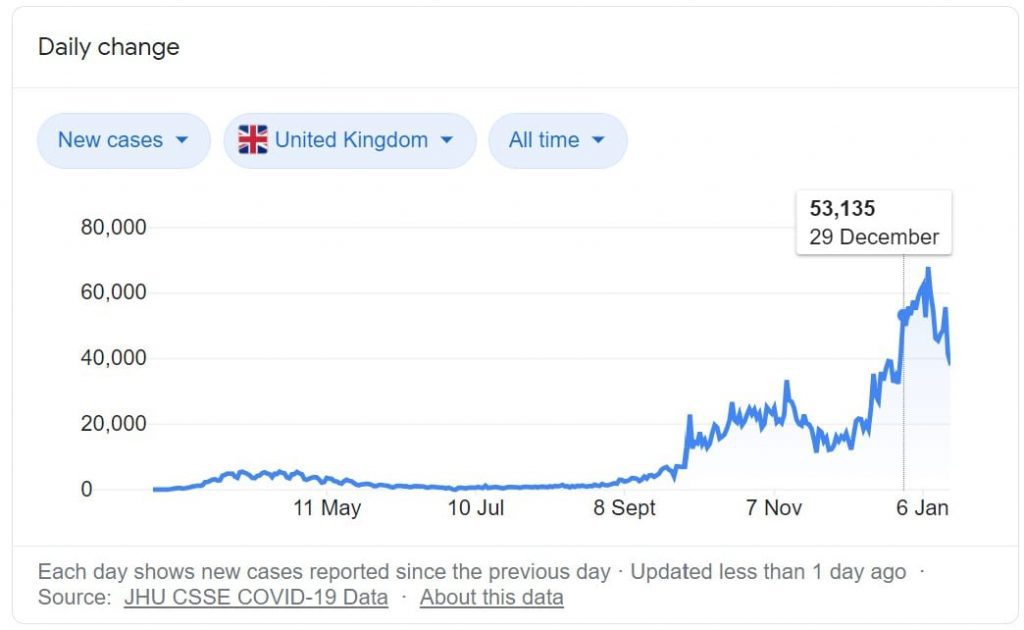
A combination of the new UK strain and a relaxation of rules over the festive period means that new infections are rapidly increasing.
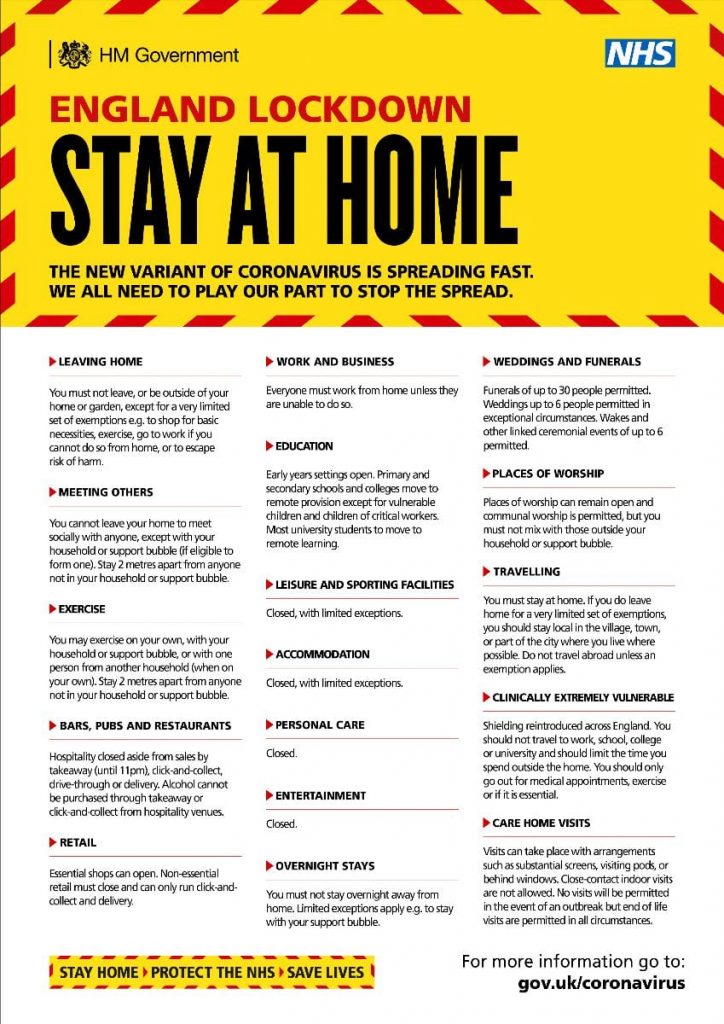
On 4 January 2021, Prime Minister Boris Johnson makes another announcement of a third lockdown. Effective from 4am on Wednesday 6 January.
In the speech he says: “On 29 December, more than 80,000 people tested positive for Covid across the UK – a new record.
“The number of deaths is up by 20 per cent over the last week and will sadly rise further. My thoughts are with all those who have lost loved ones.”
Vaccinating at Speed!
By 18 January 2021, almost four million people in the UK have had their first Covid-19 jab. Care home residents and carers were first, then the over 80s and health care workers. Next up were over 75s and during week commencing 18 January the over 70s will begin to get theirs.
On Tuesday 19 January 2021, the UK reported its highest daily number of Covid deaths – 1,610. Another 33,355 new cases were recorded – less than half the peak figure of 68,053 on 8 January 21. Almost 4.3m people have had their first vaccine.
26 January 2021 marks a very grim milestone. The UK records 100,000 deaths from Covid-19.
And 30 January 2021 is another date we don’t want to remember. It marks a year since the first Covid-19 patients were identified, in York in 2020. The previous day the patients had been moved from a hotel in York to Castle Hill Hospital near Hull. Read how Covid 19 started in the UK here.
Coronavirus Diaries – December 2020
8 December – Vaccination Begins
The light at the end of the tunnel! Tuesday 8 December 2020 is a landmark day, when the first vaccinations are given. The world’s first coronavirus jab was delivered safely into the arm of Margaret Keenan in Coventry.
800,000 doses are initially available of the Pfizer/BioNTech jab. It’s the one that must be stored at -70C so roll-out is more challenging than it could be.
Up to four million doses are expected by the end of December.
14 December – Mutant Virus Discovered
To add insult to injury, a mutant type of virus has been found, possibly linked to higher infection rates in the south of the UK.
But it’s what virus do – they constantly adapt. This virus jumped from animals to humans about a year ago and has been making about two changes a month since then. A sample from December 2020 would have about 25 mutations when compared to a sample from Wuhan in December 2019. The nasty little thing is still trying to work out how to infect us most effectively.
Health officials remain convinced the new vaccine will work against this variant. If mass immunisation drives mutation in it, we’ll need to have regular update vaccines, like we do with seasonal flu.
By mid December 2020, the number of new daily cases is on the rise again.
It’s being driven by the new variant, which is much more easily transmitted. Unfortunately it’s becoming widespread just as we enter Christmas week, when Covid restrictions are slightly eased.
The consequence of the festivities + the new strain = a surge in cases at the end of December 2020. We’re now into the third wave…
Coronavirus Diaries – November 2020
5 November – Lockdown 2 Begins
New national coronavirus restrictions come into force on 5 November 2020, for a four week period to Wednesday 2 December. They replace the Tier 3 restrictions currently in place.
During this time, you must stay at home except for specific reasons including:
- Education
- Work where working from home is not possible
- Exercise or recreation outdoors on your own, with your household or with one other person
- For medical reasons or appointments and to escape injury or harm
- To shop for food and essentials
- Provide care for vulnerable people, or to volunteer
- To provide childcare
9 November 2020 – A Vaccine In Sight…
It was announced today that a vaccine – developed by US firm Pfizer and German-based BioNTech – could prevent 90% of people getting Covid-19.
Responding to the news, The British Medical Association, which represents doctors, says GP practices are ready to step up to the challenge.
Plans are being drawn up for clinics to run 12 hours a day, seven days a week to get a coronavirus vaccine to as many people as possible as soon as it’s available.
It looks like the vaccine – if final testing trials go well – won’t be available until into 2021. But at least there’s light at the end of the tunnel.
11 November 2020 – 50,000 UK Deaths
A grim statistic. Way back before the whole COVID thing escalated, the medical advisors said we’d be very lucky if deaths were below 25,000. At which we all gasped.
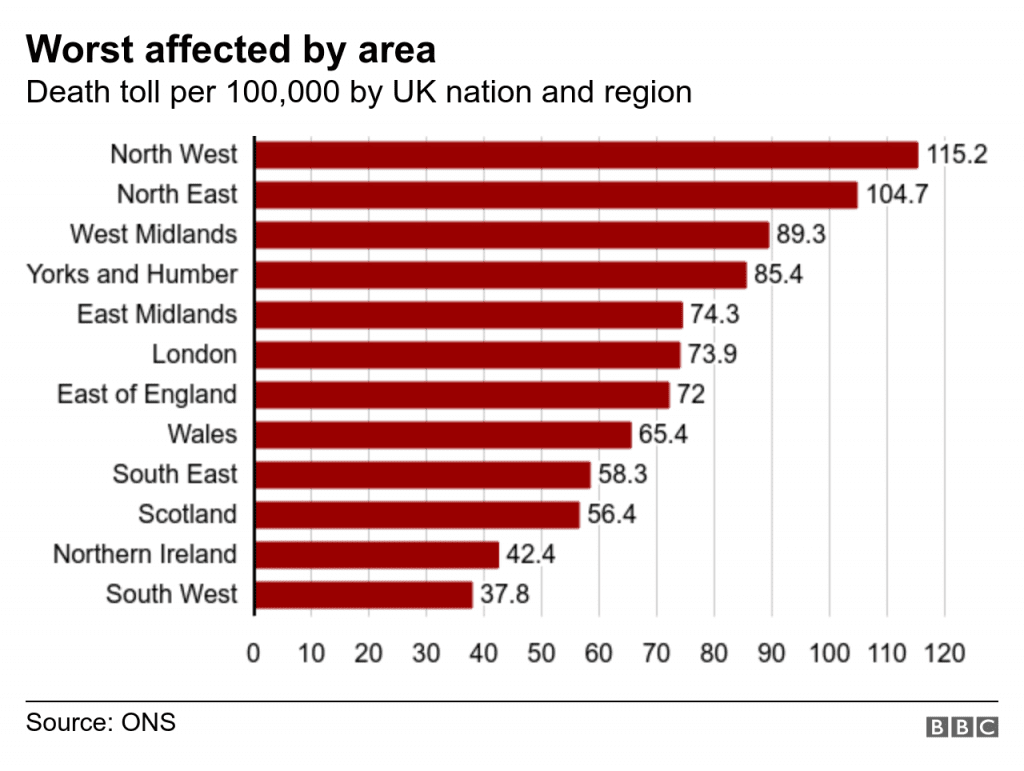
These are two interesting graphs, published by the BBC –
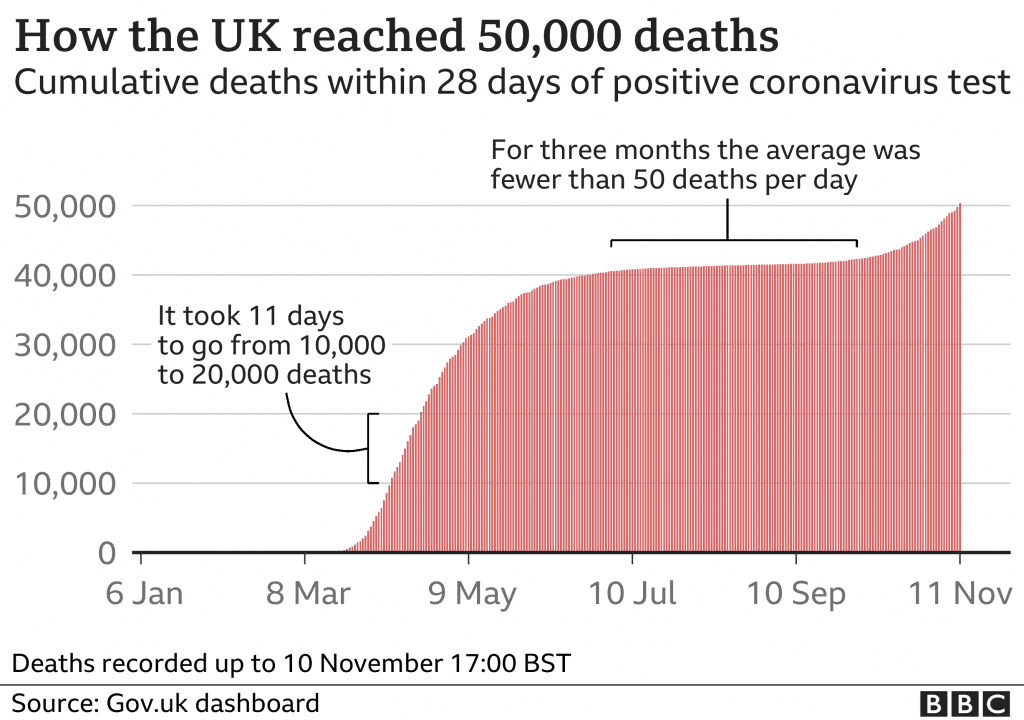
50,000 people is a lot of people. A lot of families. Our thoughts go out to them all. Unfortunately, the north west is the worst affected area. So far.
26 November – What happens when Lockdown 2 Ends?
From 2 December 2020 the second national lockdown ends. On Thursday 26 November the announcement was made about which Tiers we revert to.
Lancashire, including Blackpool, Fylde and Wyre, reverts to Tier 3 of the government alert level system. Tiers will be strengthened compared to the previous tier measures in order to prevent a return to growing infections and to help suppress the virus.
This means:
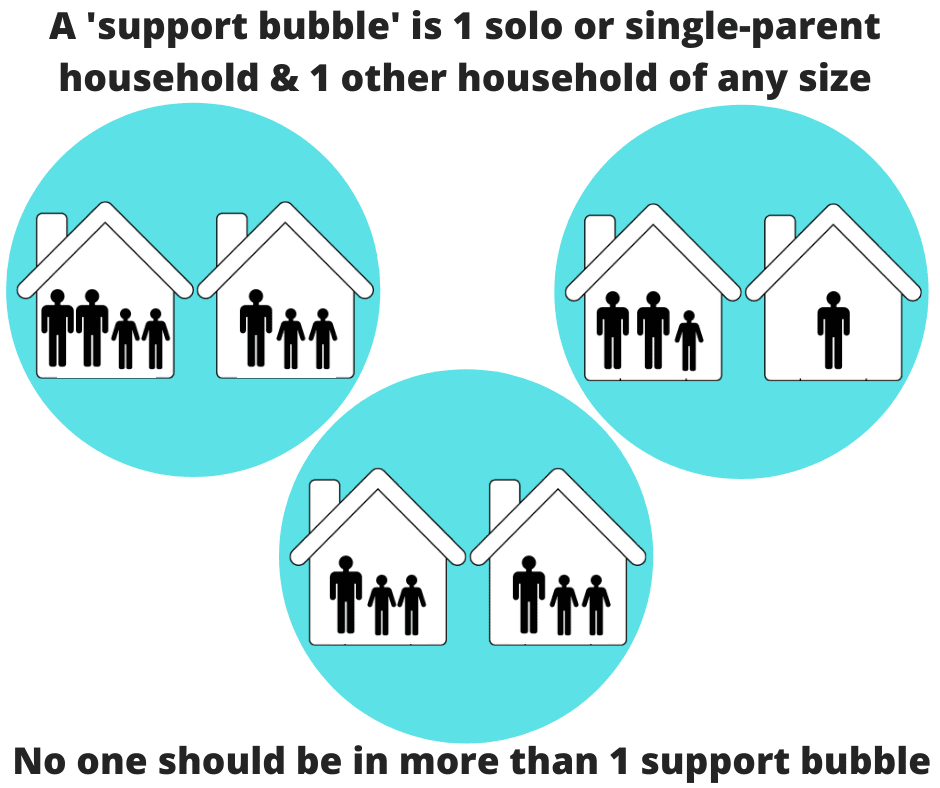
- No mixing of households indoors, apart from support bubbles. You can meet in a group of up to six in some outdoor public spaces (e.g. parks, public gardens)
- You can continue to travel to venues or amenities which are open, but should aim to reduce the number of journeys you make where possible. You should avoid travelling to other parts of the UK, including for overnight stays other than where necessary, such as for work, education or to receive medical treatment
- Everyone who can work from home should do so
Some businesses and venues can continue to operate / reopen, in a COVID-secure manner:
- Essential and non-essential retail, including indoor and outdoor markets and car boot sales
- Certain leisure and sporting facilities such as gyms and leisure centres, excluding group exercise classes (including fitness and dance). Saunas and steam rooms should remain closed
- Personal care and close contact services such as hairdressers and barbers, beauty salons, tattoo parlours, nail salons and spas
In Tier 3, a number of businesses and venues must remain closed:
- Hospitality settings, such as bars (including shisha bars), pubs, cafes and restaurants. Takeaway, delivery, click-and-collect, drive-through services can continue
- Accommodation such as hotels, B&Bs, campsites, and guest houses
- Indoor entertainment and tourist venues
The rules will change again for the Christmas period.
Coronavirus Diaries – October 2020
13 October – New Three Tier Alert Levels
The Prime Minister set out how the government will further simplify and standardise local rules by introducing a three tiered system of local COVID Alert Levels in England. The levels are medium, high, and very high.
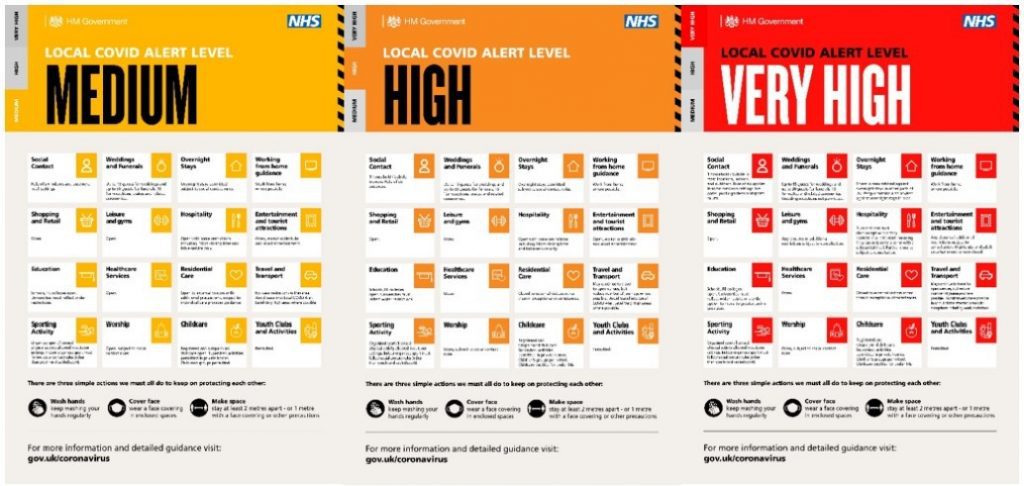
The “very high” alert level will apply where transmission rates are causing the greatest concern, based on an assessment of all the available data and the local situation. In these areas, the government will set a baseline of prohibiting social mixing indoors and in private gardens, with the Rule of Six allowed in open public spaces like parks and beaches.
Pubs and bars must close unless they operate as a restaurant – which means serving substantial meals, like a main lunchtime or evening meal. They may only serve alcohol as part of such a meal. People will be advised not to travel in and out of these areas.
Level 3 for the Fylde Coast
Lancashire, the Fylde Coast and Blackpool moves into “very high” Covid alert level – from midnight 16.10.20
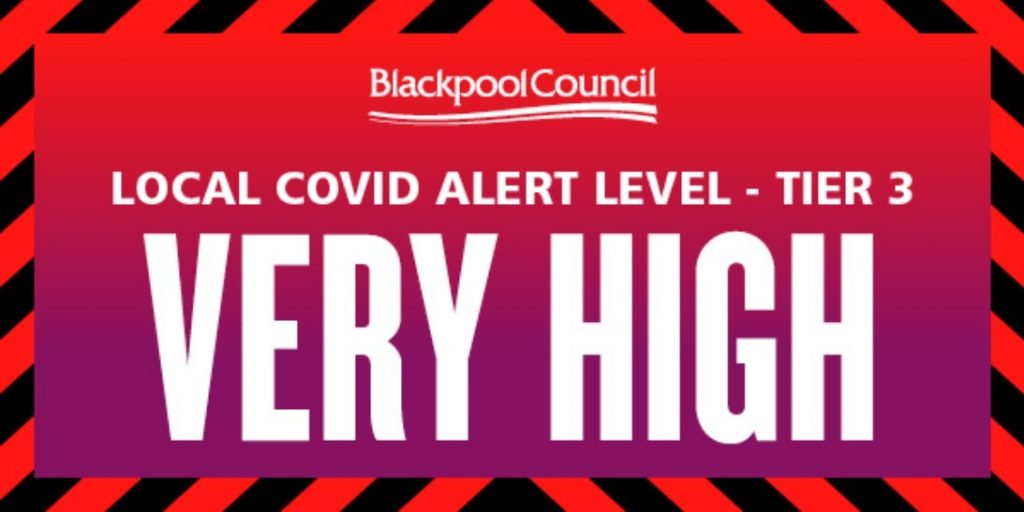
- Bars and pubs to close midnight 16.10.20, other venues from Monday 19.10.20
- No socialising with people indoors unless you live with them or they’re in your support bubble
- Government pledges additional support for businesses and residents
- You must not socialise in a group of more than 6 in an outdoor public space such as a park or beach, the countryside, a public garden or a sports venue
- Try to avoid travelling outside the very high alert level area or entering a very high alert level area. Other than for work, education or for caring responsibilities or to travel through as part of a longer journey
- Residents should avoid staying overnight in another part of the UK, and others should avoid staying overnight in the very high alert area
From 00.01 on Monday, the following venues will also close:
- Licensed clubs
- Adult gaming centres
- Bingo halls
- Casinos
- Bookmakers and betting shops
- Children’s soft play centres
Car boot sales will also be prohibited. Universities are being asked to move to remote learning where possible.
What’s a Support Bubble?
Coronavirus Diaries – September 2020
Here we go again! By the second week of September, infection rates are rising a bit too quickly across the UK. Hospitalisations still remain low, largely because the patients are mostly young people this time.
Education resumes in September 2020. After six months, children go back to school and young people back to college and university.
Back to work. The government urges employers to recall homeworkers back to covid-safe workplaces. Many town and city centres are turning into ghost towns while office workers are missing.
Back to winter preparations. With the winter upon us, the campaign to encourage people to have a flu jab begins. We’ve got ours booked, have you?
Back to restrictions. On Wednesday 9 September it’s announced that gatherings of people will be reduced from 30 to 6, as of Monday 14 September.
Visit Fylde Coast goes back to sharing ‘keep safe’ messages…

The Rule of 6
Updated advice from the UK Government is that from the 14th September guests to venues and attractions should stick to the latest guidance. You should not meet in groups of more than six people, to help protect yourselves and each other when visiting venues. COVID-19 Secure venues can still host larger numbers in total, but groups of up to 6 must not mix or form larger groups.
New Coronavirus rules – Tuesday 22 September 2020
Information correct at time of publication 19.9.20
There’s been a significant rise in the number of cases, and signs that hospital admissions are starting to increase. So more stringent measures are being introduced to protect residents from the spread of Covid-19. The aim is also to prevent the need for a much tighter lockdown.
Restrictions do not include Blackpool at this point. Rates of infection in Blackpool are low but rising.
But Blackpool residents and businesses should stick by the rules – or risk the introduction of the same lockdown restrictions imposed on the rest of Lancashire.
What are the New Coronavirus Restrictions in the Fylde Coast & Blackpool Area?
Blackpool is a unitary authority area. Neighbouring Fylde (Lytham and St Annes) and Wyre (Cleveleys and Fleetwood) are both under Lancashire County Council’s jurisdiction. Collectively this part of the world is known as the Fylde Coast.
Lytham, St Annes, Cleveleys & Fleetwood
Are all subject to the new restrictions which are in force across Lancashire from Tuesday 22 September.
With a high rate of positive cases in the 15 to 44 age group, the concern is that this will spill into the older and vulnerable groups. Please do not mix between households indoors and keep outdoor mixing as low as possible. Use public transport only for essential journeys like school, work and health appointments. Try to stay and shop locally.
New rules:
- Residents must not socialise with other people outside of their own households or support bubble in private homes and gardens
- Hospitality for food and drink will be restricted to table service only
- Late night operating hours will be restricted, with leisure and entertainment venues including restaurants, pubs, and cinemas, required to close between 10pm to 5am
Residents of Lancashire are also advised to stick to the following guidance to further reduce rates of infection:
- Only use public transport for essential purposes, such as travelling to school or work
- Avoid attending amateur and semi-professional sporting events as spectators
Blackpool
Continues to be covered by the current national restrictions.
Dr Arif Rajpura is Director of Public Health in Blackpool. He emphasised that the decision to exclude all of Blackpool in the latest announcement was taken by government based on infection rates which are comparatively lower in the resort than other parts of the county.
He said that while the rates in a few areas of Lancashire were lower than Blackpool’s, the government had decided to impose restrictions across public health/upper tier authority footprints – hence the reason why the whole of the Lancashire County Council area was included and Blackpool wasn’t.
Stricter rules on wearing face coverings, if you are able to wear one, also come into effect. Including when visiting hospitality businesses unless and until you are seated at a table. If you are planning on visiting any hospitality businesses, please download the NHS Test and Trace app and get used to the workings of it before Thursday 24.9.20.
NHS’s COVID-19 App
The new NHS Covid-19 app goes live in England and Wales on 24.9.20
The app allows users to ‘check-in’ to venues such as restaurants, pubs, cinemas, and hairdressers by scanning a QR code on entry.
Businesses need to first download their own dedicated QR codes to print and display within their premises.
The time and date of the customers check-in, along with a venue identifier, is stored securely on the user’s smartphone for 21 days.
If it is later found that the user has been at the same venue at the same time as someone who later tests positive for coronavirus, it will allow Health Protection Teams in England and Wales to anonymously alert users who may have come into contact with COVID-19, via the app.
The use of QR codes will help businesses to meet the new legal requirement in England to record the contact details of visitors to their premises.
Businesses currently using their own QR code systems are encouraged to move to the NHS COVID-19 app QR code process. It is essential that businesses maintain an alternative check-in method, such as a handwritten register, for visitors who do not have the app. By law, businesses must store these details for 21 days and share them with NHS Test and Trace where requested.
As well as allowing users to check-in at venues, the NHS COVID-19 app will enable users to check symptoms, book COVID-19 tests online and will provide real-time alerts about the coronavirus risk level in a user’s postcode location (users provide the first half of their postcode when they initially download the app).
Where users are advised to self-isolate, the app will display a countdown timer to help them keep track of their self-isolation period.
Residents are being encouraged to use the new app when it launches on 24 September to support the NHS Test and Trace service to function more efficiently, whilst also protecting users’ anonymity.
Nobody, including the Government, will know who or where a particular user is. The app is focused on effective tracking of coronavirus and helping to stop the spread.
Only by continuing to work together and playing our part in tackling COVID-19 can we limit the spread and save as many lives as possible. We encourage everyone to participate so we can keep levels of community transmission as low as possible here in Blackpool and the Fylde Coast.
Get your unique QR code poster to display in your business ahead of 24 September at www.gov.uk/create-coronavirus-qr-poster. Posters should be displayed at all entry points to the venue.
One Million Deaths
On 28 September 2020 the world wide death toll passed the 1 million mark.

Coronavirus Diaries – July & August 2020
Okay, we confess, even we have coronavirus fatigue by now!
The virus doesn’t seem to do so well in warmer weather. Restrictions are still in place, kids are still on holiday. So things tick along for a few weeks, gradually feeling more and more like the ‘old days’.
Couple of notable things from the summer:
- On 24 July it becomes a requirement to wear face masks in shops
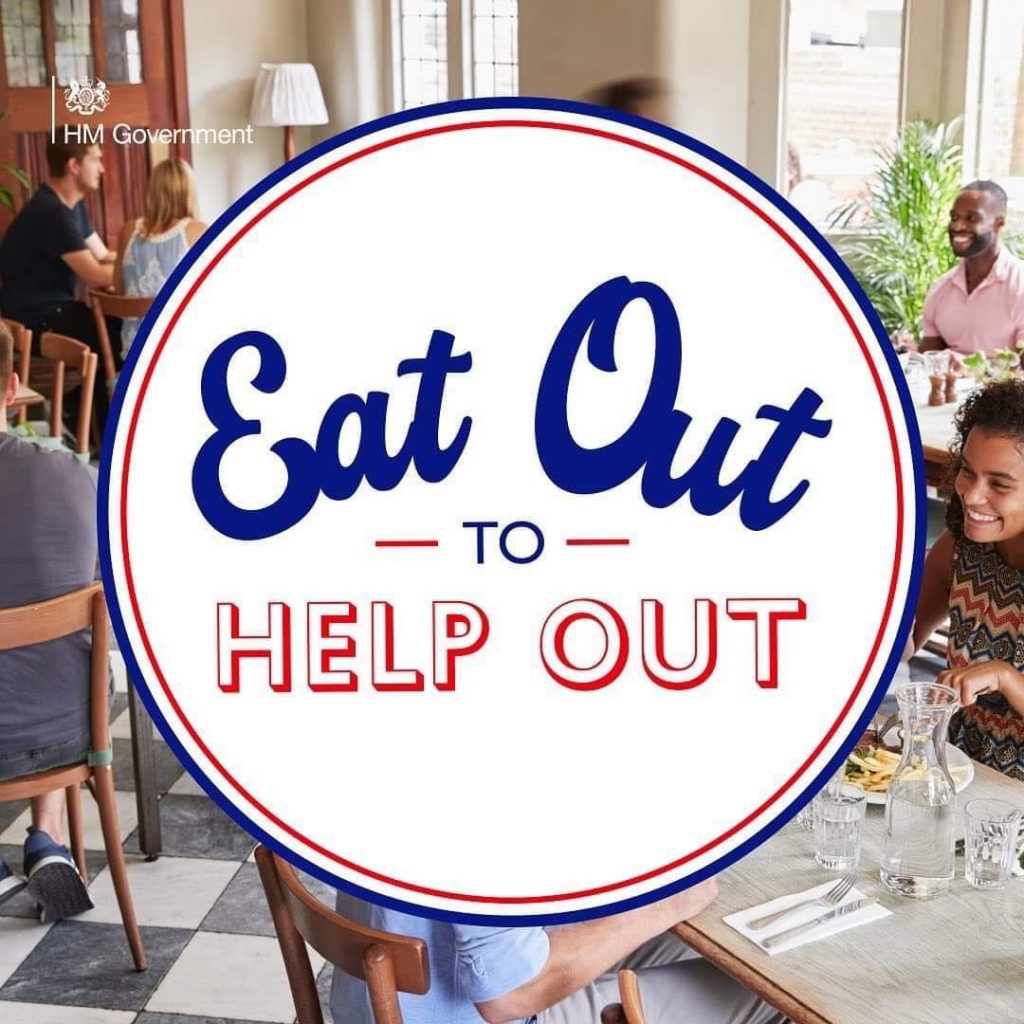
- From 1-31 August, the government’s ‘Eat Out to Help Out’ scheme tempts people back into restaurants, with a 50% off deal on eat-in food Mon – Weds.
Coronavirus Diaries – June 2020
Just as we suspected, the weather was glorious all through lockdown. It only started to change as restrictions began to be eased! You couldn’t make it up.
This month does, however, carry a grim statistic. On 5 June 2020, the death toll here in the UK from coronavirus passed more than 40,000 according to government figures. A total of 40,261 people have now died in hospitals, care homes and the wider community.
Although the national rate of transmission and daily death rate continues to fall, there’s concern about the still higher levels here in the north west.
On 15 June, after 84 days of lockdown, non-essential shops began to re-open. We went for a walk along Victoria Road West at Cleveleys to see what was happening on the town centre. This is the latest in our series of local ‘walks’ – daily videos for people who love the Fylde Coast but can’t get here.

Queues are reported in town centres all over the UK as shoppers stand in line to wait for their favourite retailers to reopen. UK Primark stores have especially long queues! Kate Yates captured the length of the queue for Primark in Blackpool. It stretched from the front doors, along Upper Bank Hey Street, and two thirds of the way up Victoria Street!

Coronavirus Diaries – May 2020
So April turns into May and the UK continues with its strange ‘new normal’.
On the last day of April it was confirmed that the UK is past the peak of the first phase. Bearing in mind it’s an artificially limited peak because people are staying home. However, the death rate continues to fall and the ‘R’ rate falls too. (R is the reproduction rate of the virus – by 10 May its between 0.5 and 0.9).
On 10 May 2020, Prime Minister Boris Johnson addresses the nation with this outline of how lockdown might end.

Garden centres are set to reopen and people can go outdoors to exercise as much as they wish. Those who cannot work from home should now return to work. The use of public transport should be avoided. Air travel passengers to the UK will be quarantined on arrival. Bars, tourism venues and attractions are to remain closed.
Stay Alert
The ‘stay at home’ message becomes ‘stay alert’. Now, more than ever, we all need to be careful.
- Keep 2m away from people,
- We must keep washing our hands.
- The new changes – and the next steps – are all dependent on keeping R (the reproduction rate) below 0.
Over the May Bank Holiday weekend, a row breaks out around the Government’s chief advisor Dominic Cummings. Specifically whether he should have travelled to Durham to spend his coronavirus isolation time at a family property there.
On Monday 25 May it’s announced that all retail stores can reopen from 15 June, assuming infection remains under control.
Test and Trace
NHS Test and Trace goes live on Thursday 28 May 2020. A huge team of 25,000 people will act as detectives, identifying and locating those who have been in contact with people who test positive.

Anyone deemed to be at risk of infection will be told to isolate for 14 days, even if they don’t have any symptoms.
This is the point where national lockdown restrictions might be lifted, in favour of more local measures.
The weather is glorious during the last weekend of May 2020. Easing of restrictions encourages people to come out and enjoy the sunshine and beaches all over the UK are busy. Cleveleys beach is about as busy as it gets.

However, opinion is divided about whether this is an issue. Many people comment on social media that it’s OK. Others (Visit Fylde Coast included) are worried about virus transmission. Especially as this area has one of the highest R rates in the country – currently standing at about 1.6.
From 1 June 2020. Outdoor markets and car showrooms will be able to reopen as soon as they are able to meet the COVID-19 secure guidelines to protect shoppers and workers.
From 15 June 2020. All other non-essential retail including shops selling clothes, shoes, toys, furniture, books, and electronics, plus tailors, auction houses, photography studios, and indoor markets, will be expected to be able to reopen if the Government’s five tests are met and they follow the COVID-19 secure guidelines. It gives them three weeks to prepare.
Coronavirus Diaries – April 2020
It’s 1 April and you could be forgiven for thinking that all of this is a sick April Fool’s joke… The UK death toll also rose sharply today with 544 cases being reported in the last 24 hours.
A further 569 deaths are reported at 2pm on Thursday 2 April 2020, including well-loved comedian Eddie Large.
On Sunday 5 April, the Queen made a rare broadcast to the nation.

On the evening of Sunday 5 April, Prime Minister Boris Johnson was admitted to hospital as he was still suffering from symptoms. By the evening of Monday 6 April he had been transferred to intensive care as his symptoms worsened.
After 7 days in hospital, Boris was discharged from hospital on Sunday 12 April, to continue his recovery at Chequers.
Another Three Weeks of Lockdown
Foreign Secretary Dominic Raab announced the lockdown extension at the daily press conference on Thursday 16 April 2020.
Current restrictions will remain in place for at least another three weeks.
On 16 April 2020, 103,093 cases were confirmed, of which 13,729 people had sadly died. 1,918 have recovered.
A total of 72 patients have now died in hospital on the Fylde coast after testing positive for Covid-19. The latest figures from NHS England show that five more deaths have been recorded in the last 24 hours for Blackpool Teaching Hospitals NHS Foundation Trust, which runs Blackpool Victoria Hospital. There have now been more than 190 deaths across Lancashire.
Human Vaccine Trials
On Thursday 23 April 2020 the first-in-human trials of a potential coronavirus vaccine were carried out by a team in Oxford.
Two UK teams are working extraordinarily quickly to try and get a suitable product into mass production. Normally this process takes years and years. What would normally take five years is being done in five months.

20,000 Deaths
In March, the government’s chief scientific adviser, Sir Patrick Vallance, said keeping deaths from coronavirus below 20,000 would be a “good outcome”.
On 25 April 2020, that unpleasant milestone was reached, with 20,000 deaths being recorded in hospitals. That figure doesn’t include deaths in care homes, hospices, or at home/in the community, so the true figure will be a lot greater.
To date four other countries have announced an official number of coronavirus-related deaths exceeding 20,000. They are the US, Spain, Italy and France.
Globally, more than 200,000 people have died with coronavirus, according to Johns Hopkins University, with confirmed cases standing at more than 2.8m.
Testing, Testing, Testing
From Wednesday 29 April 2020 coronavirus testing is open to all care home residents and staff. Plus anyone over 65 and everyone who must leave home to work. The expansion means millions more people in England are now eligible.
The aim is that anyone will be able to get tested if they have symptoms. That’s crucial when lockdown restrictions are eased as part of the “test, track and trace” strategy to keep it under control. A contact-tracing app that could also help is said to be two or three weeks away.
The death toll in care homes and the community was added to the daily count on Wednesday 29 April. The figure now stands at a sobering 26,097.
The death toll in care homes and the community was added to the daily count on Wednesday 29 April. The figure now stands at a sobering 26,097.
Past the Peak
Boris Johnson is back at the podium for the first time on Thursday 30 April for the press conference where it’s announced that the UK is past the peak of the first phase of the disease.
This DOES NOT mean that the crisis is over, and there is a long way to go yet. But it is encouraging that we are going in the right direction. For now the message remains. Stay at home, save lives.

Doing our Bit during Lockdown
During the coronavirus pandemic, Visit Fylde Coast pledges to do our best to keep you connected to the seaside and coastal community.
We focus our efforts on lifting your spirits – there’s lots to see across all of our websites. We’ll also be asking for your photos and contributions. Please join in! ??
- LOTS online across all eight websites. Find them all in the ‘Home’ tab
- Live broadcasts on our Visit Fylde Coast Facebook page
- Catch up on VIDEO DIARIES in this playlist
- Lots to watch on our YOUTUBE channel
- Watch the beach and seafront with our WEBCAMS
- Sign up for your weekly ENEWS
- Read CHRISSIE’S BLOGS
- Join our new GARDENING CLUB – while we can enjoy it!
- Stuck for what to eat from store cupboard stuff and leftovers? Have a look at our COOKING pages
We will, of course, continue to send out your weekly email newsletter where possible.
Coronavirus Diaries – March 2020
On 3 March 2020, the government publishes their Coronavirus Action Plan.
13 March 2020 – first case confirmed in Blackpool.
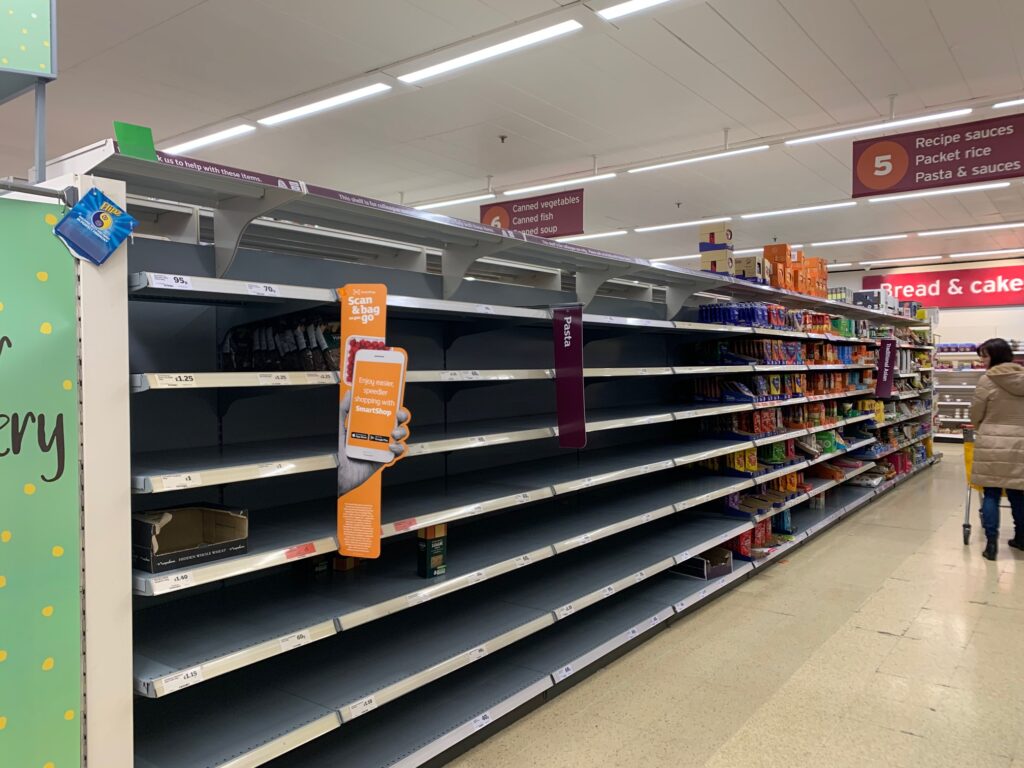
During the weekend of 14 March, the great Toilet Roll Rush of 2020 began. For some reason, they were the first item that everyone thought of stockpiling. The shelves started to clear and toilet rolls became like gold dust – very hard to find.
Escalation of the Crisis
Monday 16 March – We took our usual weekly trip to the little Sainsbury’s at Bispham. Much busier than usual, many of the shelves are already empty. Including bread, tinned, pasta/rices and long life food. And toilet rolls? Well, they’re nowhere to be seen!
Daily Press Conferences
Also on Monday 16 March, Prime Minister Boris Johnson began holding daily press conferences at 5pm. These are televised and provide extraordinary insight into how the country is dealing with the Covid-19 crisis.
In the first conference he sets out the broad view of the current situation. And explaining how we are all expected to make radical changes to our daily lives in order to limit the impact.
‘Social Distancing‘ is to become the new norm for probably the next four months. We are asked to go out to public places only when we have to. That means all socialising, meeting friends, and generally doing anything nice should be cancelled.
Anyone who demonstrates symptoms of coronavirus should now ‘self isolate‘. It’s 7 days if you live alone. Or 14 days for everyone in affected families. Wash your hands is the advice for everyone.
Tuesday 17 March – the government issued advice warning against unnecessary social contact. They recommended that we all stop going to pubs, bars, restaurants, theatres and public places.
Escalation of Social Distancing
Wednesday 18 March – yesterday’s advice only served to escalate the panic buying. Photos appeared on social media of bare supermarket shelves across the country. By now it’s not just toilet rolls and long life food that you can’t get hold of. As shoppers worry about the availability of food, supermarket fridges and freezers are stripped empty.
Supermarkets begin to ration the quantity of items that shoppers can buy. Many of them are offering a priority hour for older customers only. Independent food retailers are offering delivery and collection facilities.
Everything closes for now
Thursday 19 March. By now the government has intervened with insurance companies after issuing advice that we shouldn’t socialise. Now, venues can claim against their insurance policies where they are covered for closure due to pandemic illness. Even though their closure may be on advice, rather than a compulsory request.
Venue closures and event cancellations are coming thick and fast. People are staying away from public places as instructed. And venues are playing their part in suppressing the escalating situation by closing their doors.
Here at Visit Fylde Coast we decide to try and brighten up your lives with live Facebook posts. Here’s the first test one, fresh from the beach!

As we’re on a mission to make the best of a bad job, we’ll also be sharing some tasty ‘make-do-and-mend‘ recipes and tips. The first one is bread and butter pudding
School Closures
Also on Thursday 19 March it’s announced that UK schools are to close. They shut their doors to close at the end of the following day, on Friday 20 March.
As a rule of thumb, it’s known that children aren’t generally badly affected by Coronavirus. School closures are to prevent the nations children from becoming carriers and spreading it like wildfire to people who would be badly affected, or even killed by it.
At this stage it’s unknown whether schools will reopen before the start of the new school year in September. GCSE and A level exams won’t take place this year either.
Friday 20 March.
Blackpool Council launches a Business Support helpdesk and their Corona Kindness campaign, bringing people together who need help and can offer it.
Many more Blackpool attractions temporarily close, including The Blackpool Tower, SEA LIFE, Madame Tussauds and the three Piers.
Stay at Home
At their press conference at 5pm on Friday 20 March, the Government announce that pubs, bars, cafes and restaurants should close after service tonight. Nightclubs, cinemas and gyms will also follow suit in a strengthening of measures to tackle the outbreak. Takeaways will remain open.
On 23 March 2020 we are all told to stay at home. Keep away from other people who you don’t live with. Only go out for essential reasons.
Chancellor Rishi Sunak announces a previously unheard of package of financial support for everyone, in order to curtail the spread of the virus.
No need to Stockpile
On Saturday 21 March, the supermarkets announce what they are doing collectively to feed the nation. There is enough food to feed everyone – the only problem at the moment is getting it into stores as quickly as people are clearing the shelves. We are told that there is no need to stockpile. Over a BILLION pounds worth of extra food has gone into homes in the last week. Please use some of it while the shops get their shelves full again!
Big name high street retailers also start closing their doors. A new top or a pair of shoes isn’t a necessary purchase. We expect that more high street stores will follow.
Meanwhile, here at Cleveleys, it’s almost like life is carrying on as normal and people have no idea what’s happening in Italy…
Socially distanced
Here at Rabbit Towers we’ve socially distanced ourselves, unless we’ve had to go out to buy something. Then we’ve sent one person on a mission. Our couple of shopping errands and Facebook investigations have combined to reveal that too many people aren’t taking this seriously in our neck of the woods. PLEASE STAY AWAY FROM OTHERS.
If you’re going out to buy something, keep 2m or 6′ away from everyone else. If you live near to the beach (or a park) and can go for a walk, do it while social distancing. TAKE THE ADVICE SERIOUSLY.
If you live further away from the coast and fancy a day out at the seaside. DON’T. Please stay away.
Mother’s Day
Sunday 22 March is also Mother’s Day. It dawns bright, clear and sunny – a lovely day from start to finish. It’s clear that the Great British Public think that they can carry on doing just what they want to, as beaches, parks and public places are mobbed, all over the country.
Here on the Fylde Coast we are astonished at how many people flock to the seafront. Cleveleys, Blackpool, St Annes – they’re all busier than ever. We spend the day on social media, begging people to do the right thing.
First thing on Monday morning 23 March, we change all of our social media headers.
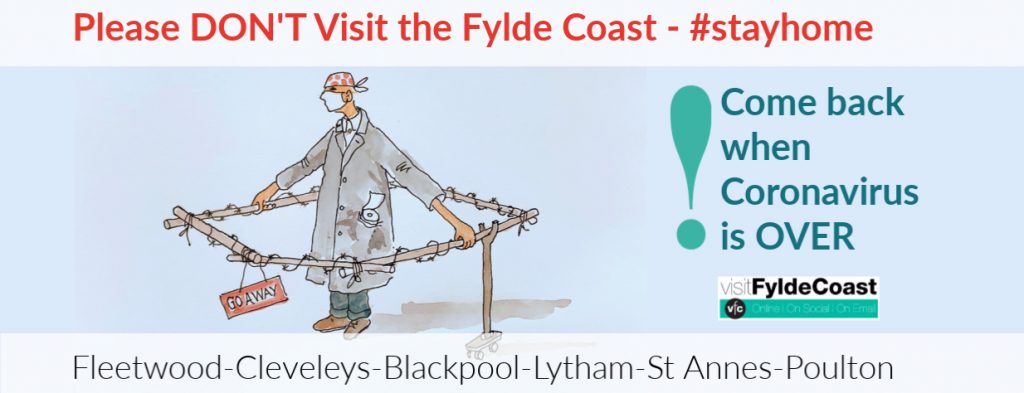
The government issues further guidance “Essential travel does not include visits to second homes, camp sites, caravan parks or similar, whether for isolation purposes or holidays. People should remain in their primary residence. Not taking these steps puts additional pressure on communities and services that are already at risk.”
Strict New Curbs on Life in the UK
The Prime Minister’s press conference didn’t take place as usual at 5pm on Monday 23 March. Instead, there was an announcement at 8.30pm.
Strict new measures are now in place, to limit the spread of the disease. It’s the next chapter in our coronavirus diaries, and shows how serious a situation it is.
We’ve also transcribed the announcement for you.
Boris Johnson’s Message to the Nation, 23.3.20
“From this evening I must give the British public a very simple instruction: you must stay at home. Because the critical thing we must do is to stop the disease spreading between households.
That is why people will only be allowed to leave their home for the following very limited purposes:
- Shopping for basic necessities, as infrequently as possible.
- One form of exercise a day, for example a run, walk, or cycle, alone or with members of your household.
- Any medical need, to provide care or to help a vulnerable person.
- And travelling to and from work. But only where this is absolutely necessary and cannot be done from home.
That’s all. These are the only reasons you should leave your home.
Please do not –
- You should not be meeting friends. If your friends ask you to meet, you should say no.
- You should not be meeting family members who do not live in your home.
- You should not be going shopping except for essentials like food and medicine, and you should do this as little as you can. And use food delivery services where you can.
If you don’t follow the rules the police will have the powers to enforce them, including through fines and dispersing gatherings.
New closures –
To ensure compliance with the government’s instruction to stay at home, we will immediately:
- Close all shops selling non-essential goods, including clothing and electronic stores and other premises. Including libraries, playgrounds and outdoor gyms, and places of worship.
- We will stop all gatherings of more than two people in public, excluding people you live with.
- And we’ll stop all social events, including weddings, baptisms and other ceremonies, but excluding funerals.
Parks will remain open for exercise but gatherings will be dispersed.
Absolutely Necessary
No prime minister wants to enact measures like this.
I know the damage that this disruption is doing and will do to people’s lives, to their businesses and to their jobs. And that’s why we produced a huge and unprecedented programme of support for both workers and for business.
And I can assure you that we will keep these restrictions under constant review. We will look again in three weeks (mid April) and relax them if the evidence shows we are able to.
But at present there are just no easy options. The way ahead is hard. And it is still true that many lives will sadly be lost.
A New Way of Life
So on Tuesday 24 March, the new curbs on life in the UK have succeeded in taking a lot of people off the streets. Our nominated shopper makes a visit to the supermarket because we’ve run out of milk and bread, and reports that it’s a lot quieter than it has been.
However, this particular supermarket is still finding it a challenge to get stock onto the shelves. They’re 12 members of staff down and recruiting for new people. Many of the working staff are on the checkouts so they can’t fill shelves at the same time. The shelves of long-life food are still empty.
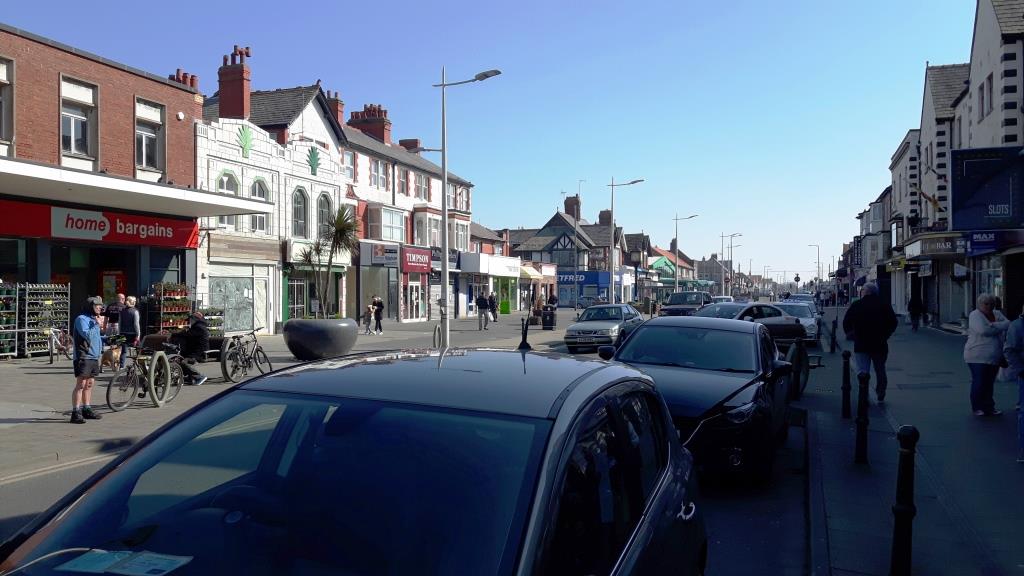
Meanwhile on the seafront at Cleveleys, the morning dawns quiet and eerie. However, by lunchtime people are travelling to park at the seafront to go for their daily walk. While it’s not strictly against the rules, it’s not quite what the rules intended is it?
Please get the message!
We post a photo on Facebook and it’s disappointing to see just how many people still aren’t getting the message.
The UK death toll shoots up today, to 87 unfortunate people in a 24 hour period. The government is converting an exhibition centre in East London to a 4000 bed hospital.
On Thursday 25 March the message is still clearly not getting through. Cleveleys promenade continues to be thronged all day with people visiting by car to walk about in the beautiful sunshine and enjoy the paid holiday.
Meanwhile, police forces all over the UK are issuing notices to tell people that essential travel does not include getting in the car to take the dog somewhere nice for a walk. #stayathome
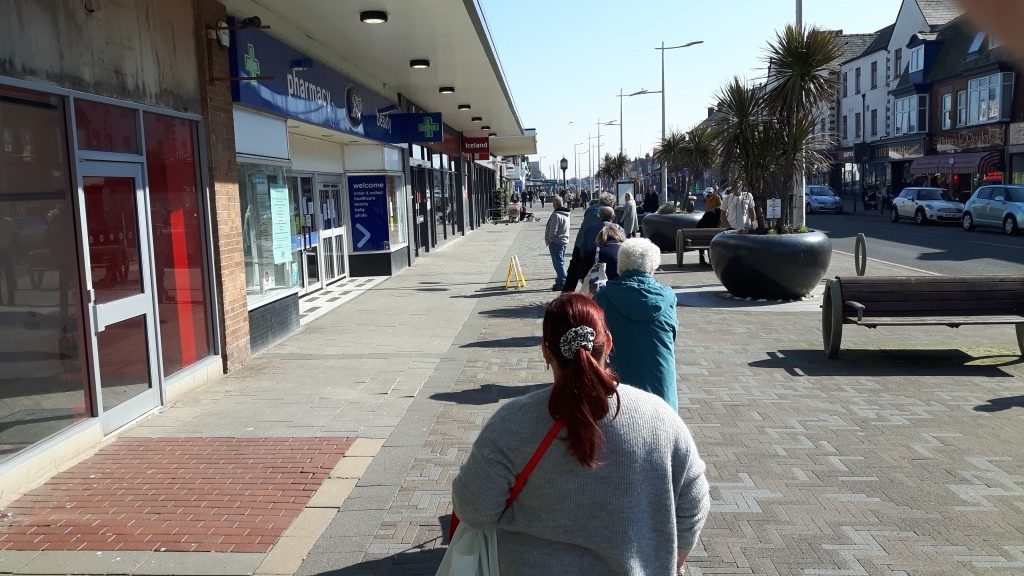
Supermarkets are now implementing strict social distancing measures. Orderly queues space people 2m apart and most are allowing one in and one out. There is now more food on the shelves. Support networks for vulnerable people are swinging into action.
Over 50,000 people register as NHS volunteers in 24 hours.
Support for the Self Employed
The long-awaited statement from the Chancellor, Rishi Sunak regarding COVID-19 support for the self-employed was announced on 26 March. The Chancellor said that the scheme will benefit some 95% of people whose main income source is derived from self-employment.
- Those that qualify will receive a cash grant from HMRC based on 80% of profits, up to £2,500 per month,
- The initial grant will be for the three months, from 1 March through to the end of May 2020, but could be extended for a longer period.
- There is no need to apply to HMRC as they will contact you if you are eligible.
Clap for Carers
Also on Thursday 26 March, it was quite moving to hear the street come to life at 8pm with the sound of clapping, whistles and cheers. Following the lead of other countries, the UK showed public appreciation for frontline workers.
THANK YOU to the NHS, carers, delivery people, food producers & retailers, bus & train drivers, utility workers – EVERYONE who is keeping us fed, watered and alive. #stayhome people and #savelives ❤️
Another Day another Challenge…
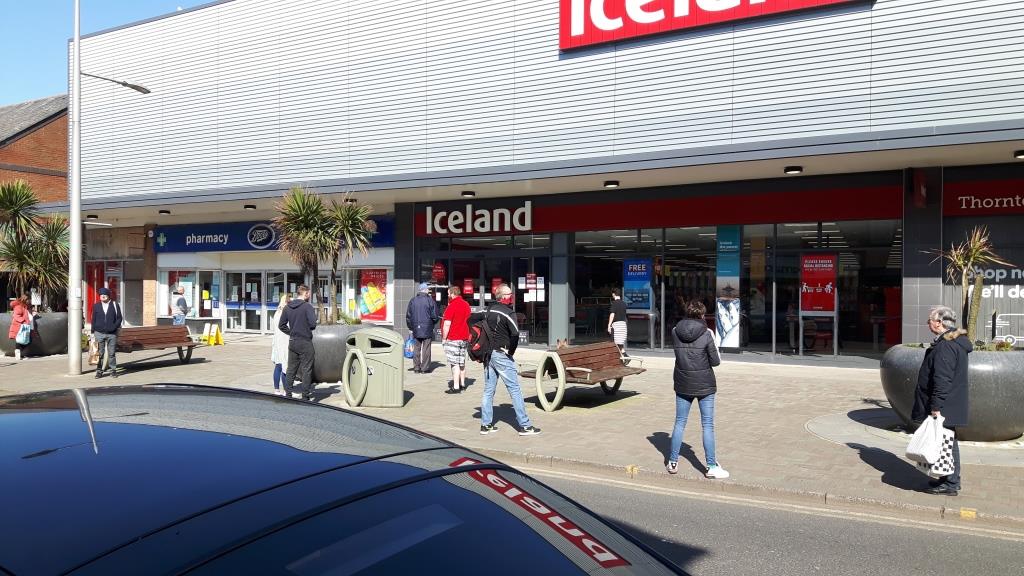
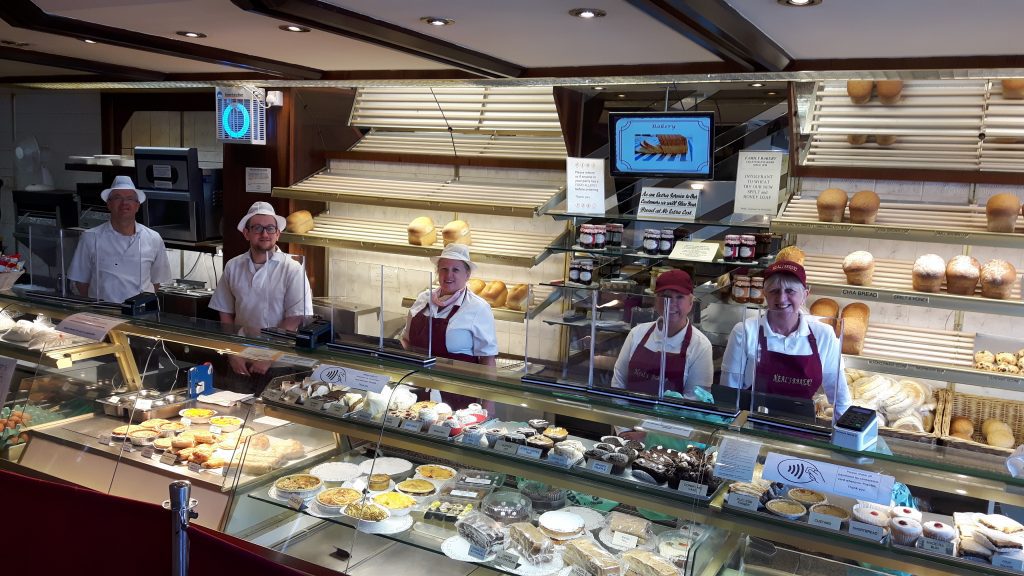
Our nominated shopper went to Cleveleys for food on Friday 27 March and gave the shops on Victoria Road West 10/10 for textbook social distancing.

Coronavirus proves that it doesn’t discriminate between who it infects. It’s already been announced this week that Prince Charles has it, with mild symptoms. But today, Friday 27th, Prime Minister Boris Johnson has tested positive, along with Health Secretary Matt Hancock and Chief Medical Officer Chris Whitty is self isolating with symptoms.
On 29 March, all Blackpool Trams were temporarily suspended and the Blackpool Transport bus service was reduced.
And so March draws to a close…
By 31 March there had been five deaths at Blackpool Victoria Hospital.
The figures announced at 2pm reveal that 393 people have died in the last 24 hours – the biggest daily increase so far. This brings the total number of UK deaths so far to 1801.
Although it’s said that social-distancing is having an effect on suppressing the rate of infection, we’re not out of the woods yet. By a long way.
Lancashire Resilience Forum
Here in Lancashire, a number of agencies are working together to respond to the Covid-19 outbreak. They include the police, health service, local authorities and fire service.
They’re all operating under a group called the Lancashire Resilience Forum (LRF). You’ll hear this group being referred to a lot over the coming weeks as they do their best to provide you with messages in a coherent and considered way.
What does the LRF do?
The LRF has robust and well tested plans in place for dealing with emergencies such as pandemic flu and making sure that people get the health and other advice they need.
Together they are working around the clock to ensure that every eventuality is taken into account and resources are there to deal with the virus.
Some of the priorities include:
- protecting vulnerable groups,
- ensuring we continue the distribution of essentials such as fuel and food,
- looking after our key workers,
- making sure those who need it have access to the correct protective equipment,
- and ensuring we’re in the best position to care for the seriously ill who need hospital treatment.
What can you do to help?
We are being very clear in saying that this is the worst crisis our county has faced since wartime. The first and most important request is that people follow the advice being given by central government. If this isn’t strictly adhered to, it could mean people dying unnecessarily in Lancashire.
The second thing we ask is that you support us by sharing the messages we will be providing, with your friends, family and any community groups on social media which you may be a part of. It is important that factual information from trusted sources is being circulated, rather than third hand news or speculation.
Coronavirus Diaries – February 2020
New Legal Powers. On 10 Feb 2020, Health & Social Care Secretary Matt Hancock MP announced strengthened legal powers to protect public health.
Worldwide, the virus is spreading. Throughout February the virus was reported in Iran, Pakistan, Brazil, Georgia, Greece, North Macedonia, Norway and Romania.
Coronavirus Diaries – January 2020
On 22 January it was recorded in Thailand, Japan, China, South Korea, Taiwan and US.
By 31 January there were cases in Australia and Canada, Italy, Sweden, and Russia.
First Cases Reported in the UK – at the end of January 2020. On 30 January 2020, two Chinese nationals were identified to be carrying Covid-19 in York.
Coronavirus Diaries – December 2019
Outbreak begins in China
The news and media start reporting about a new virus which is quickly spreading around. It’s said to have started in a live animal market in Wuhan, China, on 19 December 2019.
Most of us had never heard of Wuhan. It’s on the River Yangtze in Hubei province, in central China.

Worldwide Covid-19 Situation
The World Health Organisation (WHO) has a Strategic Preparedness and Response Plan.
- It coordinates the response across regions to assess, respond to and mitigate risks.
- Improves country preparedness and response. Technical guidance documents and public advice is provided worldwide.
- Accelerates research and development.
This screenshot is the WHO worldwide map, captured on 20 March 2020.
Click here to go to the live version and see the same map as it stands today.

While you’re here…
Go to the homepage of the Visit Fylde Coast website for the latest updates.
Love the Fylde Coast? Sign up for your email newsletter. Packed full of interesting things it arrives in your inbox all 52 weeks of the year.
Join us on Facebook at our Visit Fylde Coast Facebook Group and follow us on Twitter @visitFyldeCoast
Plus hundreds of videos to watch on our YouTube channel – from all over the Fylde Coast!
Booking a stay? Pick a safe, clean and legal place to stay, at the very best price. Book using the Visit Fylde Coast Accommodation guide.


