


It’s likely that you’ll see jellyfish in British waters when you go to the coast. But of the thousands of worldwide species, only a few are commonly spotted off the UK. Beaches in the Blackpool area are more popular than ever, so what might you see when you visit the Fylde Coast?
When the sea water gets warmer in late spring and summer it leads to blooms of jellyfish food in British waters.
They typically eat small plants, shrimp or fish, and stun prey before with their tentacles before eating it. More jellyfish food = more jellyfish! And this is when you’re most likely to see them, washed up onto the beach.
Which jellyfish in British waters that you might see…
The five species which you’re most likely to see are:
- Moon jellyfish – 29% of recordings, found all around the UK from May to September
- Compass jellyfish – 19% of recordings, with a southern distribution (Merseyside to Norfolk), from June to October
- Lion’s mane jellyfish – 18% of recordings, have a northerly distribution (North Wales to Sunderland), found from May to October.
- Blue jellyfish – make up 15% of recordings, and usually found in SW England and Wales, NE England and Scotland. From May to September.
- Barrel jellyfish – 10% of recordings. Have hotspots in Welsh and Scottish waters, reported throughout the year.
The other species are the Mauve Stinger, Portuguese Man of War (which is a close relative of jellyfish) and the By the Wind Sailor (also a close relative of jellyfish). These aren’t always recorded every year, but together make up about 10% of survey records.
Moon Jellyfish
The moon jellyfish – below (Aurelia aurita) is the most widespread species. Found all around the UK coast and often washed up on beaches, usually from May each year.
Around the size of a plate, they’re recognisable by the four circles visible through the translucent white bell. You’ll also see them floating just below the surface of the sea water. Moon jellies have short, delicate tentacles that hang down from the sides of the bell.

Barrel Jellyfish
The giant but harmless barrel jellyfish (Rhizostoma octopus) is the biggest jellyfish in British waters. It can grow up to 1 metre in diameter and weigh up to a whopping 40kg. You’ll largely find Barrels in the Irish Sea and nearby waters to the north.
It occurs year round, even in winter, often found washed up on beaches in May and June.
Barrel jellyfish are translucent with a huge mushroom shaped bell and a bunch of 8 frilly tentacles below. They don’t have marginal tentacles, but do have a violet fringe around the bell.
Lion’s Mane Jellyfish
The lion’s mane jellyfish – below (Cyanea capillata) has the most powerful and painful sting of the UK jellyfish.
It blooms during the summer but is rarely seen south of the Irish Sea (west coast), or south of Northumberland (east coast). Most reports come from Scottish waters.
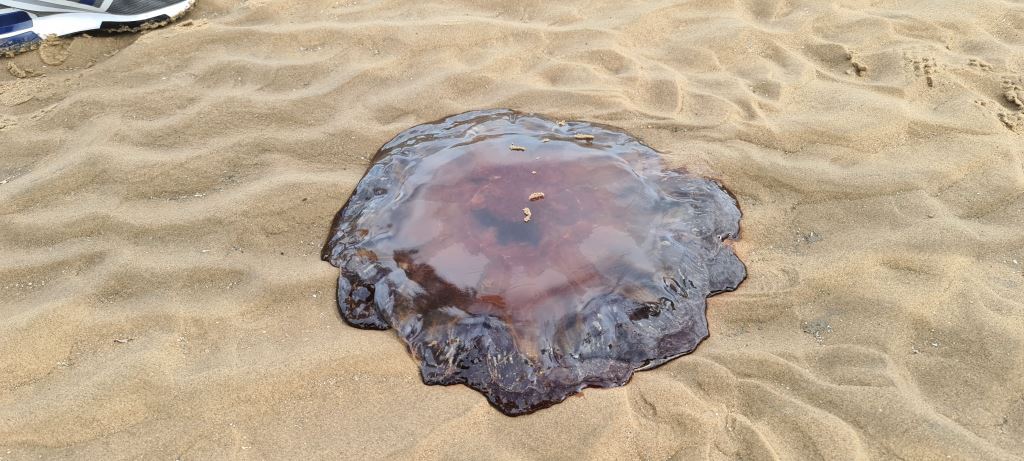
It’s easy to see where they get their name from. The long, flowing tentacles that surround the bell have the beauty and bite of a lion! A translucent brown to reddish jellyfish with a thick mane of hundreds of long hair-like tentacles; the oldest ones coloured dark red. They have thick, frilled oral arms under the bell, most often brownish in colour.
Compass Jellyfish
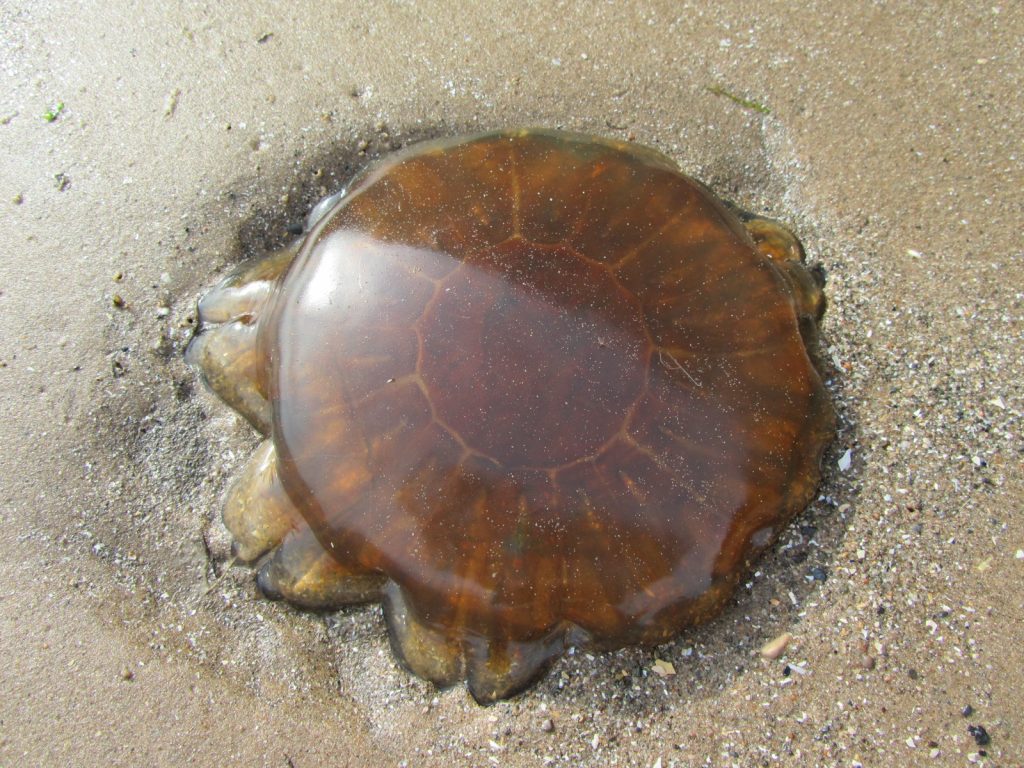
The compass jellyfish (Chrysaora hysoscella), has bizarre compass-like markings. It’s one of the jellyfish in UK seas found around all the coast and they often wash ashore in summer months.
It’s a translucent yellowish-white, with brown markings around the fringe and on the top of the bell. At the top of the bell they resemble a compass, with V shapes radiating out from a central point. Below the bell is a bunch of frilled oral arms.


Blue Jellyfish
A typical looking jellyfish, with a dome-shaped bell and stinging tentacles trailing underneath. The bell colour depends on maturity and can vary from pale yellow to purple. Not to be confused with the Lion’s mane jellyfish. This is smaller with a blue bell through which you can see radial lines. Mild sting.
Mauve Stingers
Mauve stingers (Pelagia noctiluca) are occasionally recorded from the southwest in early spring. Although a fairly uncommon jellyfish in British waters, large numbers were reported off the west coast during November 2007, 2008 & 2009.
This one usually appears a bluey purple colour with a globe shaped umbrella, covered in orangey brown warts. Long, thin tentacles hang down from around the bell, reaching a maximum of 3 metres.
Similar – but not actually Jellyfish…
Sea gooseberries, Portuguese Man of War and By the Wind Sailors are all loosely called ‘jellyfish’ but actually they’re not… Have you ever spotted any of them?
Sea Gooseberries
These pretty little orbs are often seen washed up on the beach, often in large numbers. These comb jellies look like tiny little jellyfish, but they’re actually totally unrelated.
Despite their delicate, almost ghostly appearance, sea-gooseberries are voracious predators. They feed on fish eggs and larvae, molluscs, copepod crustaceans, and even other sea-gooseberries.


Portuguese Man-of-War
MCS also received many reports of the usually rare Portuguese Man-of-War (Physalia physalia) from beaches in south-west England in the summers of 2007, 2008 and 2009.
By the Wind Sailor
By the Wind Sailor (Velella Velella) lives at the water’s surface. Its rigid sail pokes out just above the water and its purple tentacles dangle just underneath. As the sail catches wind, the jelly floats from place to place, capturing tiny fish and plankton. Thriving colonies can include millions of individuals.
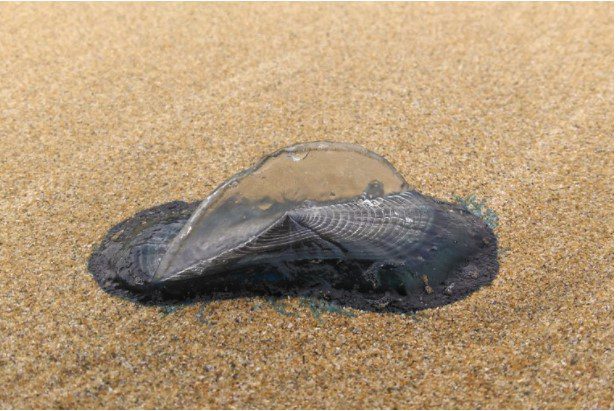
By the Wind Sailors aren’t especially common here on the Fylde Coast. But in some countries they can strand ashore in their thousands. Forming a thick mat of crunchy corpses on the beach. Have you ever found one?
Register your Sightings of Jellyfish in UK Seas
The Marine Conservation Society collects information about sightings of jellyfish in British waters. The information that you share helps scientists to understand and protect our sea life.
Why don’t you take part in the jellyfish survey? It’s fun and easy!
Look carefully at them before reporting. But remember not to touch jellyfish found in UK seas, as some species have a powerful sting.
When Jellyfish Appear in British Waters
A few years ago the Marine Conservation Society (MCS) and the University of Exeter published a report of where and when UK jellyfish occur in UK seas. It was the first one for over 40 years and was published in the Journal of the Marine Biological Association.
Details were included of over 5000 reports of jellyfish sightings of eight different species. They were sent in by the British beach going public between 2003 and 2011 for the MCS National Jellyfish Survey. More than 3,500 jelly-spotting volunteers sent in their sightings. Dr Richardson from MCS says “Our paper shows that publicly driven, collective citizen-science can help us understand our environment on a scale that would otherwise be unaffordable.”
Dr Richardson added, “We still know relatively little about jellyfish, but given the economic impacts that large numbers of jellyfish can have on tourism, fishing, aquaculture and even power generation, we can’t afford to ignore them.”
Survey of Jellyfish in British Waters
The survey is the largest of its kind and has attracted lots of jellyfish sightings. 2013 was a record year when 1,133 reports were received. The summer of 2018 also proved to be a productive year for jellyfish.
But it’s not just interesting information. Taking stock of jellyfish in UK seas in this way provides important information. It helps scientists to understand how jellyfish species react to environmental changes that influence our coastal seas, including climate change.
Have you got any photos of jellyfish that you’ve spotted off the Fylde Coast? If you have please send them in.
While you’re here…
WHAT DO YOU THINK? Why don’t you join in and leave a comment below?
Have a look at the homepage of the Visit Fylde Coast website for more of the latest updates.
Love the Fylde Coast? Sign up for your weekly email newsletter. Packed full of interesting things it arrives in your inbox all 52 weeks of the year.
Join us on Facebook at our Visit Fylde Coast Facebook Group
Don’t forget to follow us on Twitter @visitFyldeCoast


