

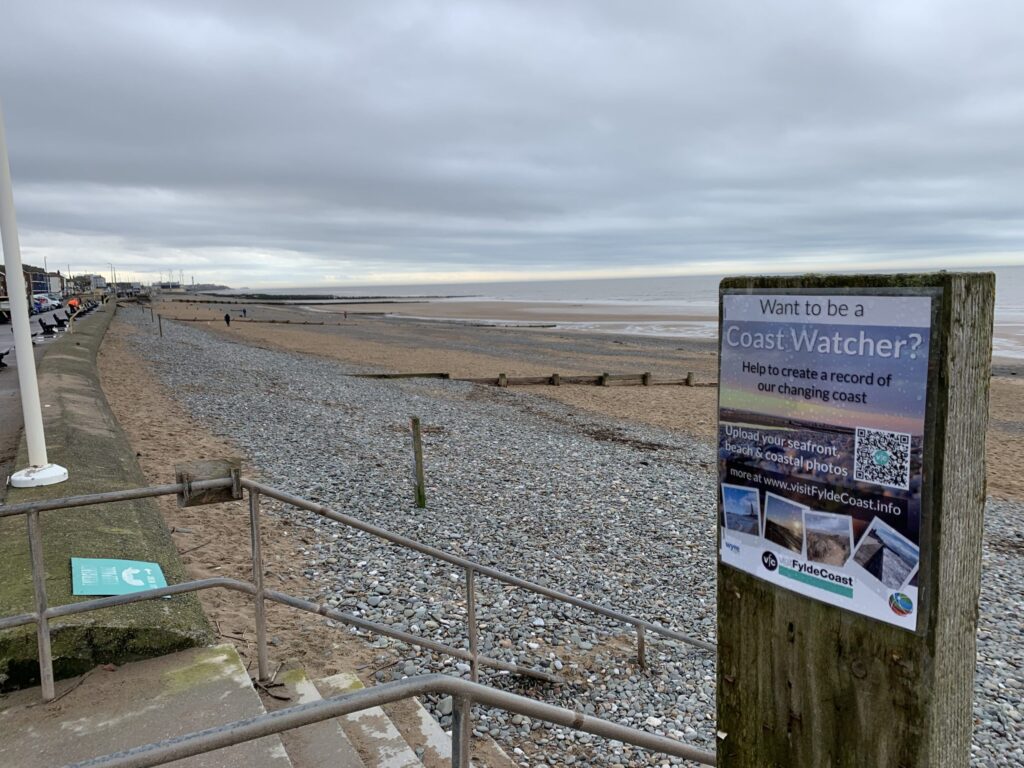
If you’ve ever walked along the sand and shingle beach at Cleveleys, you’ll know just how fast the beach can change. From the movement of shingle up and down the beach to sand moving northwards, there’s rarely a moment when there isn’t some sort of movement happening. We’ll take a look at how the weather affects beach changes how does the beach maintain itself?
Laura Brown is a Coastal Processes student at Lancaster University. She’s explored the complicated subject of what shapes the beach in this article for Coast Watchers. We’re sure you’ll agree that Laura has done a good job of translating these processes into an easy to understand form!

How the Weather Affects Beach Changes
Cleveleys beach, as many of us have experienced, has very variable weather conditions, a benefit for some and a curse for others. After all, when the rain suddenly catches you off guard, you really do feel like you’re at the mercy of the waves, with nothing to protect you but an umbrella if you’ve remembered to bring one that works!
These weather conditions shape the beach through the movement of water and wind lifting sediment and moving it along the shore, but also interact with the tides. As a result, it’s not just the weather that is important in shaping Cleveleys beach, but the tides too, as this article will explore.
Tidal Change
The macrotidal tidal range means that the difference between the high and low tides is large. In fact, this difference is typically over an 8m vertical difference at Cleveleys! This large difference means that there’s a lot of variation between the tidal levels that affect the beach.
One interesting fact is that the high tides occur every 12 hours 25 minutes. This is when the water level is furthest up the beach. But why does it take another 25 minutes?
Well if you imagine a point on the Earth, the point rotates under the Moon. The time it takes to do this is known as the lunar day. But the Moon revolves around the Earth faster than the Earth rotates, so it takes the Earth another 50 minutes to “catch up” with the Moon.
As the tidal levels change, the beach’s exposure to the waves changes too. The beach is in a constant state of flux and changes are happening even beyond what we can see. So it’s not just the how the weather affects beach changes, but the tides are important too.
How Do Waves Shape The Beach?
The beach relates strongly to weather conditions and particularly wind, something which is often all too strong at Cleveleys! As the wind becomes stronger, blows for a longer time and over a larger distance, the waves get bigger. They become steeper when they reach the coast because the depth of the water reduces, as shown in the diagram.
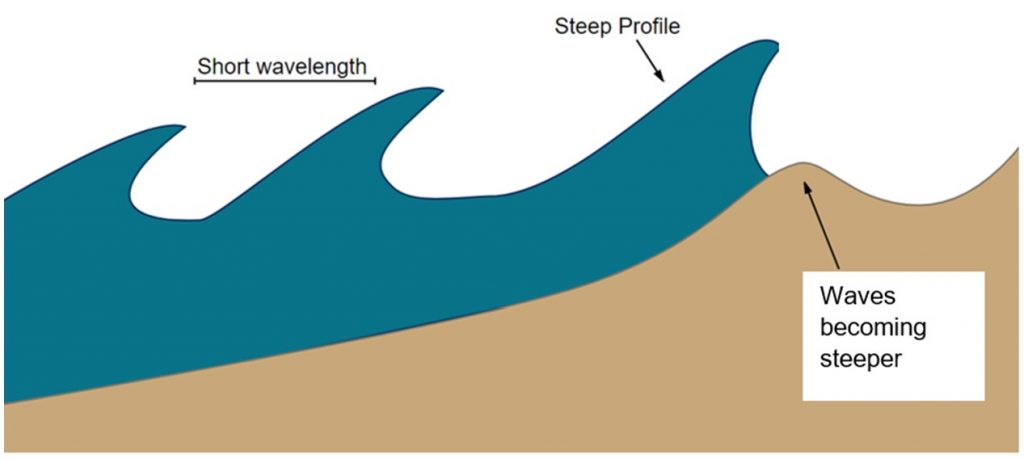
The steep waves approaching the coast are known as shoaling waves. Shoaling waves carry sediment, dropping it onshore. As the waves approach the shoreline, they encounter friction with the ground and eventually collapse as the friction becomes too much. Although the shoaling waves break and collapse, remaining bores, which are smaller waves, move sediment onshore. But this isn’t the full story. Sand is moved by wind, waves and tides and is rarely stationary. The beach is constantly changing.
How the Weather Affects Beach Changes
As I mentioned earlier, a key factor which causes the beach to change is weather. As we enjoy the calmer spring and summer weather (hopefully!), the waves are generally shorter as there is less wind energy transferred across the sea surface. These waves are usually much smaller and carry sand onto the beach as you can see below, but they can be more energetic during storms.
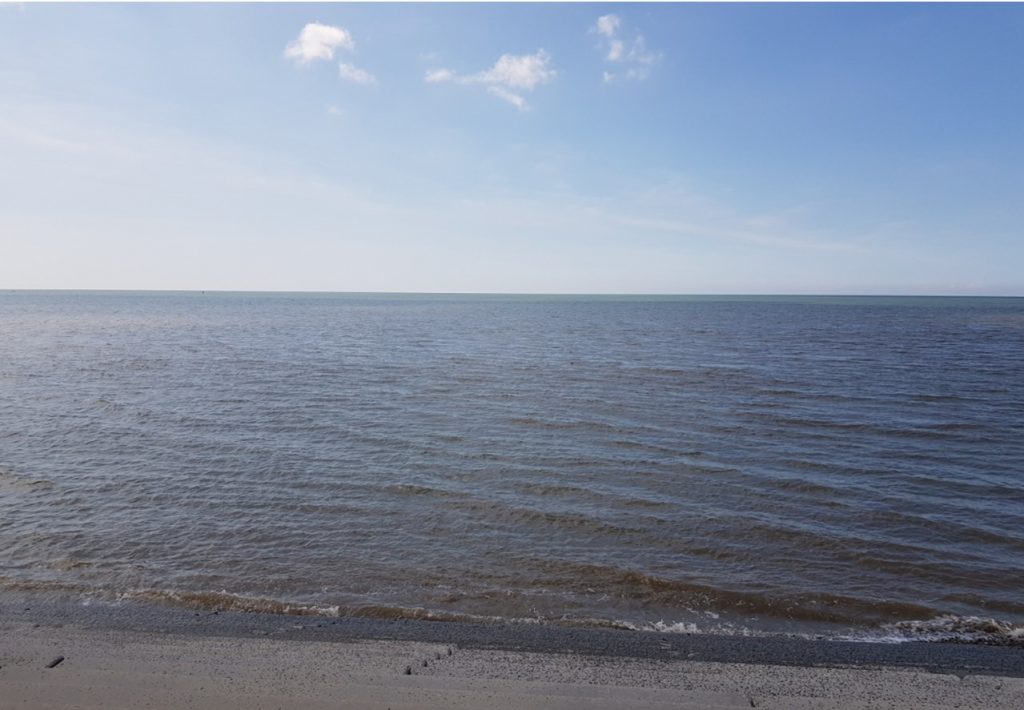
The calm weather waves have a lower height so build sand onshore, widening the lower beach. The low waves cause sand to accumulate, which eventually builds the beach. This is what many of us enjoy when we visit Cleveleys.
What happens in Winter…
In winter, the stronger winds cause waves to transfer more energy and in some ways, undo the hard work done by the spring and summer waves.
The more powerful waves, such as those shown below, transfer the sand, which was deposited by the waves earlier in the year, back offshore and deposit it beyond the coastline in a process known as undertow. Undertow is the bottom current of the large broken waves which transfers sediment back out to sea.

What happens in calmer weather…
This action is reversible though. As calmer wave conditions return, waves of lower energy pick up the sand from offshore and carry it back to the beach again, creating seasonal beach profiles which we can see in the graph below.

This graph shows how the beach profiles vary between different seasons at Profile 3 on Rossall Beach. The left hand side of the graph is the beach at low tide, the right is next to the sea wall. The line of the graph is the average shape of the beach.
The upper line, in yellow, shows the Spring profile. This isn’t higher than the Autumn profile as the graph may have you believe. In fact, the beach profile for Spring has been artificially raised, just so we can see it more clearly!
The graph shows that in Spring, the beach is generally flatter, with sediment building up. In Autumn, the dips represent channels on the beach. When powerful waves approach, they transport eroded sediment into these channels. The sand in the channel may then migrate northwards by tidal and wave-induced currents.
What may seem like a constant going back and forth between winter erosion and spring or summer build-up actually occurs on a shorter timeframe too. What really matters is the size of the waves. As the waves become larger, they have more power to shape the beach.
Why Are These Changes Important?
As I mentioned, the beach is subject to what we can imagine as a back-and-forth motion, where the beach is lost under powerful wave conditions but restored under others.
It’s important that this back-and-forth motion happens. Without it, the beach could be lost or dramatically build up and change the landscape which many of us like to visit. You can think of this like a set of scales. As sediment is lost, it needs to be replaced to keep the beach stable.
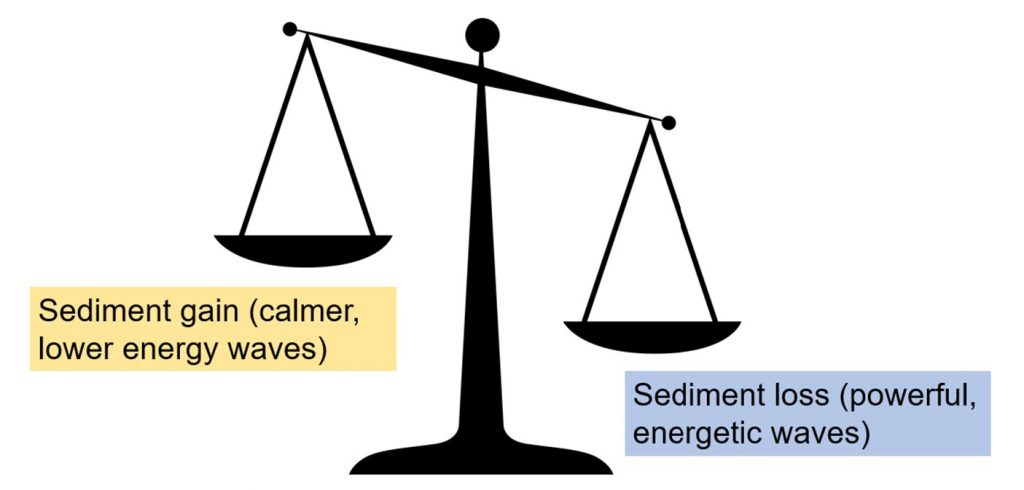
In the future, maintaining a balance between sediment loss and sediment gain is crucial to keeping Cleveleys looking as it does today. This is known as dynamic equilibrium, where changes are balanced with one another to maintain a stable beach. Whilst changes are always happening, beyond what we can see, the interactions between the wind, waves, tides and sediment movement is what shapes the beach.
While you’re here…
Have a look at the homepage of the Visit Fylde Coast website for more of the latest updates.
Love the Fylde Coast? Sign up for your weekly email newsletter. Packed full of interesting things it arrives in your inbox all 52 weeks of the year.
Join us on Facebook at our Visit Fylde Coast Facebook Group
Don’t forget to follow us on Twitter @visitFyldeCoast


