We all love the coast – there’s nowhere better than the beach – whatever the time of year. But, it can also be dangerous, so make sure you’ve got an understanding of beach safety before you go out there.
On this page –
Just Stay Alert!
The most useful thing to remember when you go on any beach is to keep your wits about you. How cautious you need to be depends on your own circumstances, and whether you’re with kids/dogs/elderly people.
Here are some things to watch out for, because all kinds of toxic things can wash up too!
Don’t let it be You…
In 2022, 266 lives were lost to accidental drowning in the UK. These deaths are preventable tragedies. Statistics reveal 40% of people who accidentally drowned had no intention of entering the water. Slips, trips and falls were often the cause of these accidents.
Many people underestimate the dangers of jumping into water or taking a dip to cool off. Unseen hazards and cold water shock can mean even strong swimmers get into trouble. Males account for 87% of these accidental fatalities, 60% of which are in inland waters such as rivers, reservoirs and lakes.
- Don’t enter the water after drinking alcohol
- Walk a safe route home after drinking, with friends and away from water
- Cold water shock can kill, walking into the water rather than jumping in can help reduce the risk.
Did you know? Between 400 – 600 people a year are drowned in the UK and 20% of incidents are at the coast. There are many reasons why people get into difficulty.
Help Yourself
If you find yourself in trouble in the water, remember to ‘Float to Live’. Tilt your head back with your ears submerged. Relax and breathe normally. Move your hands to help stay afloat. Spread your arms and legs out. Once your breathing is controlled, call for help or swim to safety.
– With education and reading information
– Obey signage warnings/information about danger
– Learn rescue and survival skills
– Don’t tamper with rescue equipment
If in Doubt Dial 999
HM Coastguard is normally the initial contact when you ring 999. They attend beach and sea incidents.
- If you see someone in difficulty, never attempt a rescue.
- Call 999 and ask for the Coastguard.
The Maritime and Coastguard Agency (MCA) and HM Coastguard (HMCG) are the government organisations responsible for preventing loss of life, continuously improving maritime safety, and protecting the marine environment in the sea around the UK.
- HM Coastguard Search and Rescue team are based out of Fleetwood (in the same building as the RNLI). They cover the coast from the Cartford Arms area on the River Wyre through to Blackpool.
- Another Coastguard team is based in Lytham (in the big car park after the sand dunes on Clifton drive). They look after the area from Blackpool to Tickled Trout on the River Ribble.
Blackpool Beach Patrol works with the Maritime and Coastguard Agency (MCA) and HM Coastguard (HMCG) and has strong links with the RNLI. These are the organisations responsible for preventing loss of life, continuously improving maritime safety, and protecting the marine environment in the sea around the UK.
Keep Safe on the Beach
Always take your mobile phone with you – the signal isn’t always perfect but it’s better than leaving it on the kitchen table where it’s no use at all!
Blackpool Beach Patrol have kindly provided this general beach safety advice. It applies on any beach which you might visit. Please take a minute to read it – especially if you aren’t used to beaches and the sea.

Beach safety signage
There’s signage at various points where you might access the beach. Other resorts may use a flag system and overseas a traffic light system may be used – so be aware when visiting different beach resorts.

- Red symbols are Prohibition
- Yellow symbols are Hazards
- Blue symbols are Mandatory.
Please read, understand and be fully conversant with them. They’re there for your safety.
Keep Away from the Edge
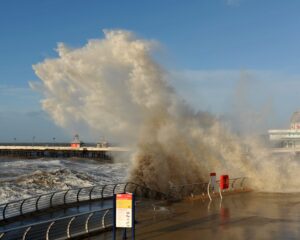
The other thing that can be very dangerous is wave dodging. Always pick a safe spot, well away from the edge if you want to take photos.
When the tide is very high with the wind against it, it blows the spray and waves up above the sea defences. There are numerous points along this coastline where people have been washed into the sea and drowned. Never underestimate it, and always keep your dogs on a lead and away from the edge.
The beach and sea is very inviting, especially on a sunny day and it’s a great way to spend your time. Just please, keep yourself, your family and pets safe.
Why do people drown? Even good swimmers can find their ability severely impaired in cold and fast moving water. Once you’re in difficulty and can’t cope, it often results in involuntary submersion.
Cold Water
Warm sunny days can be very misleading. Sea water takes a long time to warm up and can be very cold at around just 10 degrees C. It seldom reaches 17 degrees C, even on a hot summer’s day. Compared with our normal body temperature at 37 degrees C, getting in the cold water is quite a shock.
Sea temperatures in the UK are generally very chilly, with temperatures below 15 degrees most of the year. If you suddenly enter water this cold, your body can react uncontrollably, making it difficult to breath and swim. To avoid this make sure you enter the water gradually or wear a wetsuit to help you acclimatise to the temperature.
Sea Safety, Rip Currents and Big Waves
- Wherever possible, always swim at a lifeguarded beach. Find them throughout the UK and ROI at this link.
- Always read and obey the safety signs at the entrance to the beach.
- On a lifeguarded beach, find the red and yellow flags and always swim or bodyboard between them. This area is patrolled by lifeguards.
- Never swim alone. Or tell someone that you’ve gone swimming.
- If you get into trouble stick your hand in the air and shout for help.
A rip current is a body of water that flows out to sea and catches many sea-users off guard.
Did you know? 1 cubic cm of water weighs 1 gramme? Water is incredibly heavy.

Large dumping waves are the most dangerous to swim in. They can knock you off your feet into deeper water.
Waves can be dangerous even when you’re not in the water. In stormy weather, waves and spray are blown up and over the sea wall in many areas. They can be strong enough to knock you off your feet and drag you back into the sea if you get too close. Many people have drowned in this way over the years.
Always keep your dog on a lead and stay away from the edge. Remember beach safety – it’s not worth risking your life for a thrill or a photo.
Tides
The tide can change very quickly and often catch people unawares. It’s important to check the local tide times and be aware of your surroundings.
Be careful not to get cut-off by the tide when walking on the beach. Incoming tides create isolated sandbanks on the beach, like this one at Cleveleys.

The sea carves channels in the sand. They shift and move on a daily basis with each tide, particularly during strong winds. When the tide comes back in, the water first rushes through these lower lying channels to create sandbank islands.
They can be very big and it’s very easy to get cut-off from the main beach. The sandbank can often be too long to outrun. That means you’ll be wading through what can be deep, cold and fast moving water.
Do you know why the tide comes in and goes out?
Find out why, and why there’s a tide, here.
Watch the Water
On an incoming tide always watch what is happening behind you. Be aware of your exit route back to the top part of the beach.
- When you go to the edge of the sea, no matter how far out you are, have a knowledge of whether the tide is coming in or going out.
- Tide Table books give you the high and low tide times each day. You can get the same information online.
- An easy way to tell is by looking at the beach. If it is very wet the tide is going out. If it’s very dry it will be out/coming back in.
- Keep looking back to shore. ALWAYS make sure that there is a wide, dry, safe passage of sand back up the beach behind you.
- DON’T stand looking out to sea, oblivious of what’s at the back of you.
- If you’ve got a mobile phone, make sure you take it with you when you go on the beach. You never know when you’ll need it.
IF YOU’RE IN TROUBLE DIAL 999 AND ASK FOR THE COASTGUARD
Don’t understand how tides work and when you’re likely to get cut off on the beach? The answer is simple. Stick to the top sections of the beach close to the wall and make sure you can always see a route back to land. That way you’ll know that you are safe.
Here Comes the Sun!
It’s lovely to feel the sun on your skin and it really makes a day at the coast. However, you will catch the sun here much more quickly than you think.
Spending just a short time in the sun can result in sunburn, heat exhaustion or even heat stroke. Make sure that you wear suncream – apply it before you go out. And make sure that you drink plenty of water.
Missing Children
If you become separated from your child, try not to panic. Notify the Police or the Beach Patrol immediately, who will conduct a search.
In 2016 Blackpool Beach Patrol successfully re-united 146 Lost Children lost on the beach. Here’s a few ideas for how to keep a check on your little ones:

Inflatables
Don’t use inflatables in the sea, especially on an outgoing tide. It only takes a light breeze to blow an inflatable out to sea. Don’t underestimate the need for beach safety.
Mark your Equipment
In 2020, Lymington RNLI spent six hours at sea searching for a missing kite surfer. He’d already made it ashore so they looked to see how they could avoid it happening again.
The kite surfer had been seen by a member of the public who believed him to be in trouble. After a six hour search his equipment was found ashore. But without any form of identification, it was unknown if the kite surfer was safe. After the local Coastguard circulated a photo of the kit on social media, it was established that he was.
As a result of the call-out, Lymington RNLI started a Label your Kit campaign. If you’re using the sea for recreational or business reasons, mark your equipment with a contact number. Then if it’s found, it should be possible to avoid a fruitless search.

Labels (above) can be attached to equipment with your contact details. They’re available through the MCA website, in the Recreation and Water Sport section.’
Tony Cowell, Coxswain at Fleetwood RNLI said ‘This is a brilliant idea by our colleagues at Lymington RNLI. We encourage all sea users to mark any equipment with a mobile number. Use labels or even just write with a black marker pen. This could save the RNLI from unnecessary and potentially dangerous call-outs.’
Public Lifesaving Equipment
Lifebelts can be found at access points to the beach. If you do get into trouble in the sea, stick your hand in the air and shout for help. If you see someone in difficulty, never attempt a rescue.

Call 999 or 112 and ask for the Coastguard immediately.
Sinking Sand and Mud
The beach is a beautiful place but it has hidden dangers. Get the most enjoyment that you can from the beach and sea – but don’t take risks that you don’t need to.
Beaches are a natural landscape. They vary every day as the tide goes in and out. They vary from one patch to another with the natural geology of the beach. Sinking sand and mud can appear in a patch one day and disappear the next. Here’s some advice for what to look for:

Be aware of sinking sand and mud – if you put one foot down and it feels soft and ‘givey’ don’t carry on in that line. Vary your route around what is probably an isolated patch.
- If you do feel yourself sinking DON’T PANIC.
- Reverse your route out if you can.
- Spread your weight by kneeling, sitting or laying down and crawl out if possible.
- If it’s not working immediately, call 999 and ask for Coastguard. They’ll be with you as quickly as possible.
If the Coastguard do attend, they have specialist footwear – a bit like snowshoes – to spread their weight. They also have specialist equipment to get you out of the sinking sand or mud. And they have specialist training so they know how to do it safely without creating any more casualties.
Videos
This video was filmed in Cleveleys – in August! You can see how the big crashing waves could easily pull you in. This footage was all filmed at a safe distance or from behind the sea walls –

Take a look at this video, filmed on Cleveleys beach it shows exactly why sandbanks are dangerous –

‘There once was a girl who had a little curl, right in the middle of her forehead… ‘When she was good she was very, very good, and when she was bad she was horrid…’
Well that’s exactly what the sea is like! The beach and water is beautiful to look at, but it has a force and a might that will always win. Never underestimate the power of the sea.
From being washed out to sea, pulled under by a strong current or simply misjudging the conditions when they are dangerous. It’s really important to understand that every beach is different and has its own set of hazards. Here’s a short video to help you to keep safe on the beach –

It’s also a good idea to know what you might come up against while you’re walking on the beach. Especially if you’ve got a dog or small children with you as they’re more likely to touch (eat!) things they shouldn’t!

When the Worst Happens…
Despite warning advice people can and do get into difficulty on the shore. This is where the RNLI and Coastguard volunteers are invaluable. Together they rescue hundreds of people from the threat of danger each year. Sadly, sometimes they are too late.
Cut off in Fleetwood
Anne Brookes needed a dramatic rescue by the local RNLI volunteer crew when she became cut off by the incoming tide whilst walking her two dogs at Fleetwood. She teamed up with the RNLI to use her experience to warn others about the importance of checking the weather and tides. (Pictured above)
Fleetwood RNLI lifeboat launched their new inshore lifeboat Harbet following a call to HM Coastguard from National Coastwatch at Rossall. The volunteer crew arrived to find Anne waist deep in water, holding her dogs Lili Pup and RuffRock in her arms. They became engulfed by the tide during a walk opposite the Marine Lake. Take a look of this dramatic footage of the rescue below, filmed by the RNLI.
Anne said: ‘I was so relieved to see the RNLI lifeboat. The crew were fantastic with the dogs and we were so grateful to them for picking us up. It was a frightening experience.’

Deaths in 2020 at St Annes
Despite the warnings, people still get too close when wave watching and get pulled into the sea. Others were under the influence. Too many have been trying to rescue dogs (who usually get out). Some even walk into the waves deliberately.
On 15 August 2020, two boys on a visit from Dewsbury tragically lost their lives at St Annes beach. Muhammad Azhar Shabbir, 18, and Ali Athar Shabbir, 16, were found at sea by HM Coastguard and RNLI volunteers. Their bodies were retrieved the day after they were last seen, off the coast of St Annes. PLEASE DON’T LET IT BE YOU.
Drowned in Blackpool in 2015
On Saturday 11 July 2015, 26 year old Ashley West went for an evening out with his pals.
After going into the sea he couldn’t get out. His friends tried to save him but couldn’t. Eventually the Coastguard and RNLI saved him near to Uncle Tom’s Cabin. Although he was taken to Blackpool Victoria Hospital, sadly he later died. Don’t let this happen to you and your friends – don’t go in the sea when the tide is in.
While you’re here…
Go to the homepage of the Visit Fylde Coast website for the latest updates.
Love the Fylde Coast? Sign up for your email newsletter. Packed full of interesting things it arrives in your inbox all 52 weeks of the year.
👉Join us on Facebook at our Visit Fylde Coast Facebook Group. Plus hundreds of videos to watch on our YouTube channel – from all over the Fylde Coast!
📣JOIN our new VFC WhatsApp Channel for what’s happening, interesting local information, history, communities, events and much more.
Booking a stay? Pick a safe, clean and legal place to stay, at the very best price. Book using the Visit Fylde Coast Accommodation guide.