


Metal detecting has been an interesting hobby for many years. It’s popularity soared again in 2020/21 during the covid pandemic. It’s an intriguing hobby – who knows what you might find?
Rules on Metal Detecting
Take a look at the gov.uk website for the latest rules and requirements around metal detecting.
The Code of Practice for Responsible Metal Detecting provides more detailed guidance on how to search for archaeology responsibly.
If you have found potential treasure… You’re required to report it within 14 days, and follow all other legal obligations under the Treasure Act 1996. You must report any potential treasure to your local Finds Liaison Officer or the British Museum (treasure@britishmuseum.org).
Your Metal Detecting Stories
In the summer of 2021, Jason emailed with details of his amazing finds in the Lytham area.
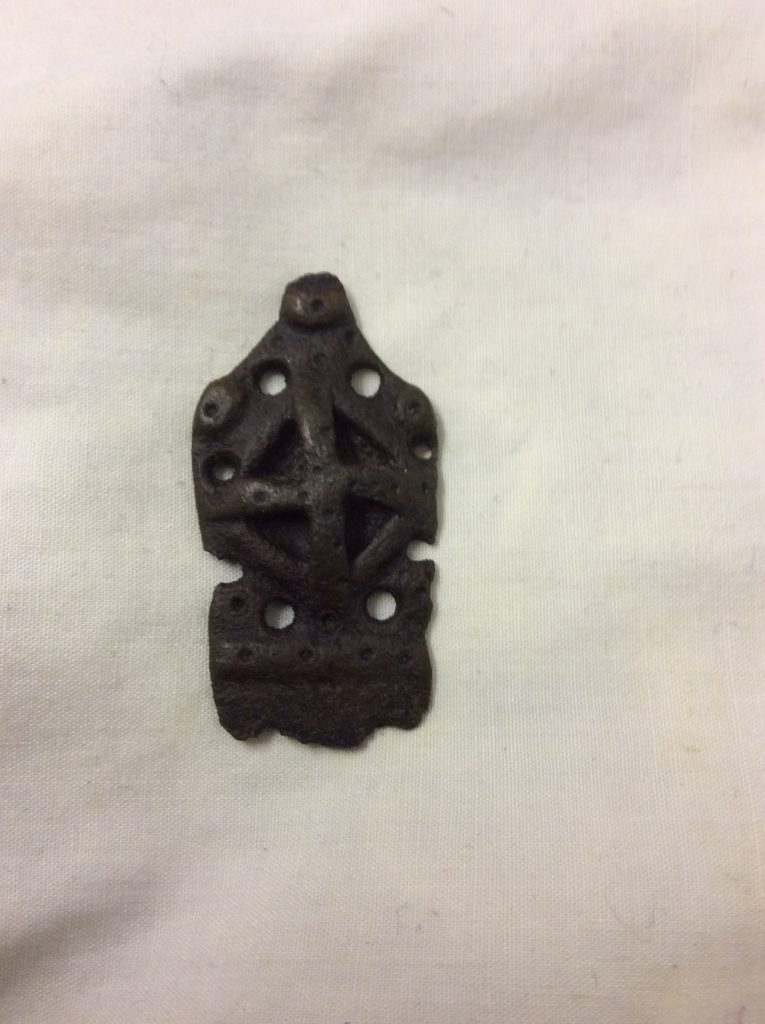
He says “I’ve done a bit of metal detecting in Lytham – I’m solely interested in history. Doing that I’ve found some physical items which tie in with the history of the area. Such as this open work strap end with a cross on it, dating from 900 to 1100 so it’s about late Saxon in date. The Harris Museum in Preston said there are only around five of these known to be found in the UK.
“I also found a small Roman coin hoard and bracelet, dating to mid 4th century. Some of these coins display the chi rho which was one of the earliest Christian symbols. Could these be the earliest items depicting Christianity on the Fylde, predating the monks by 600 years or so? These were also verified and logged with the Museum.
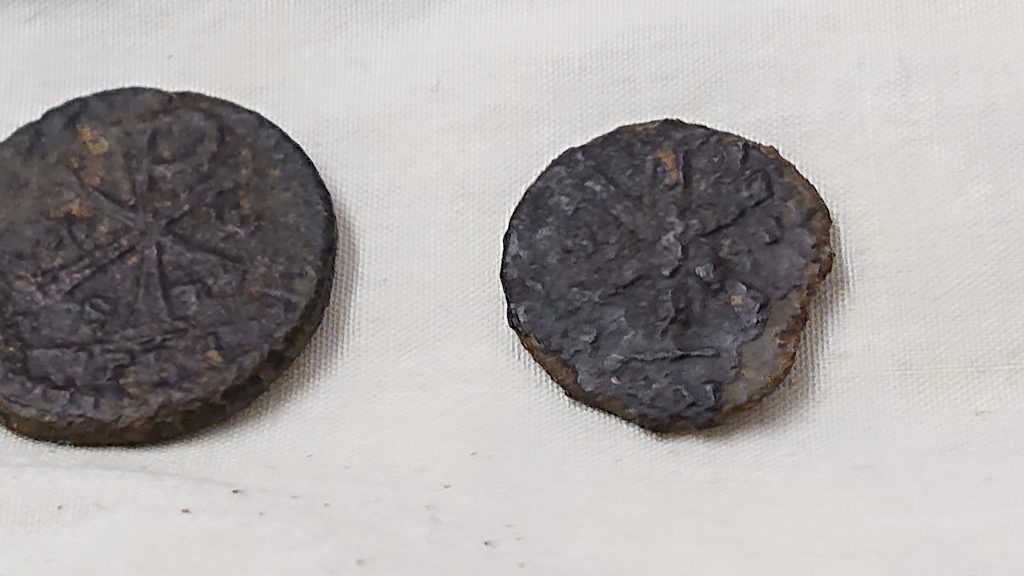
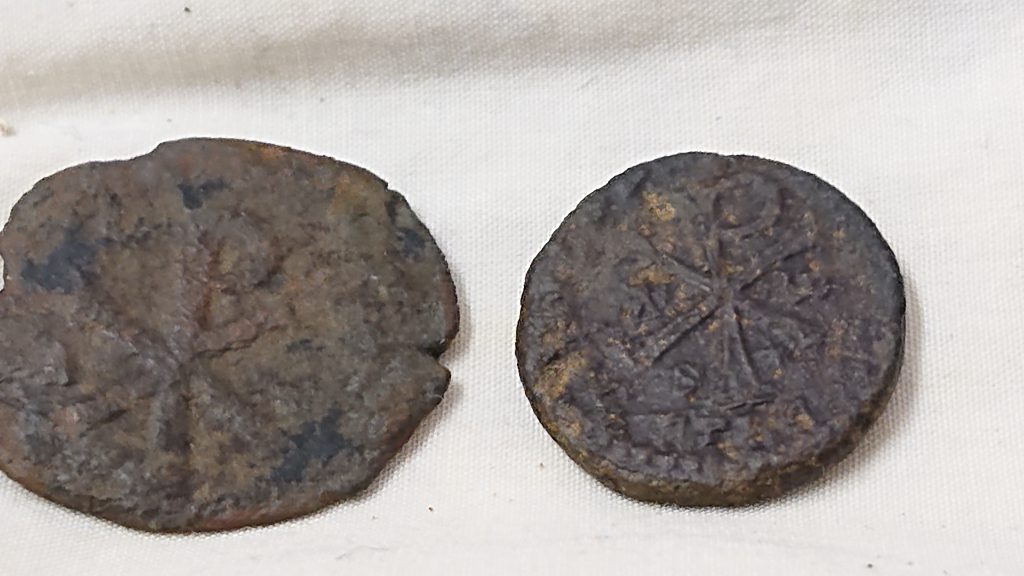
In the year 2000, someone else found six Roman coins of the same era as mine, very close to the same spot.
“These finds tie in with the Ribble as the Romans heavily used the river. As your history article says, so did the monks and the vikings. The thing is, there’s no record of Romans in Lytham, so was it a transit stop or crossing point?
“I also find lots of bits from the late 1600’s, Georgian and Victorian. Ie coins, jewellery, and old toys from the 1700s. This is what I love – finding real touchable history.”
James Turner – collecting on the beach
Way back in 2013, James contacted us here at Visit Fylde Coast, following a Facebook thread about the petrified forest that can sometimes be seen on Cleveleys beach.
He explained how, throughout school he’d had a love of ancient history and prehistory. A fascination with things owned by people from the past – the story they tell, the history of the artefact. He said “When I find something I feel a remarkable connection to the past, a wonderful feeling as I take hold and look at something. Especially if it’s been lost for a long time, not seen or touched since.”
I’d thought about buying a metal detector for years. When circumstances presented me with more time, I bought one. I couldn’t imagine a better way of touching history or realising the passion I have for connecting with the past. Metal detecting, research, the history and recording of my finds is fascinating. Metal detecting is challenging, satisfying and leaves you with a wonderful sense of discovery. For me it’s a window to the past.
…how it’s rewarding
Metal detecting is great fun but I also take it very seriously. Knowing about the history of the area I’m detecting is very important and a large part of the experience. It’s a special feeling when you find a coin or artefact from a long past era and can put it into context.
I love the freedom and peace the outdoors gives me, especially the beach. The crashing waves and the smell of salt water. The wide open space of the beach and the sea breeze never fails to blow away the cobwebs. This amazing environment helps me to relax and get into the right frame of mind to listen to and identify signals from the detector. It’s a wonderful thing, having a passion with the capability to take you into another world, away from worry and stress.
Other Passions
Besides metal detecting, my other passions include ancient history, history, wildlife, conservation and biodiversity of the Fylde coast and Ribble Valley. The birds and wildlife are an added pleasure and enhance the whole experience. I’m very environmentally aware and remove any dangerous or trash items I see on the beach. Items which might harm the environment, animals and children alike.
I like the friendly people I meet who are just walking, or more usually walking their dogs. We discuss the dogs, the beach and my finds. Sometimes I bump into a beachcomber and they tell a much more detailed account as to what has been happening on the beach, like movements of sand.
Where I Detect
I go out with my metal detector on the Fylde coast, the tidal river Ribble, old private gardens and some woodland. But all in the Fylde/Ribble locale. The whole area is rich in history but my main area of interest is the beautiful Fylde coast and its beaches.
What I’ve found while Metal Detecting
I’ve found thousands of coins both modern and pre-decimal and hundreds of artefacts mostly from the 18th, 19th and 20th centuries. Plus modern watches and jewellery but my best find to date is a bronze age ring. It’s magical to find and hold something that old.
I discovered the ring near the Ribble on what’s now waste ground, but in 1800 there was a house there. A large house with landscaped gardens and a stream at the bottom. I thought there was a chance of some older finds as a lot of soil had to have been moved around when the house was built and gardens landscaped.
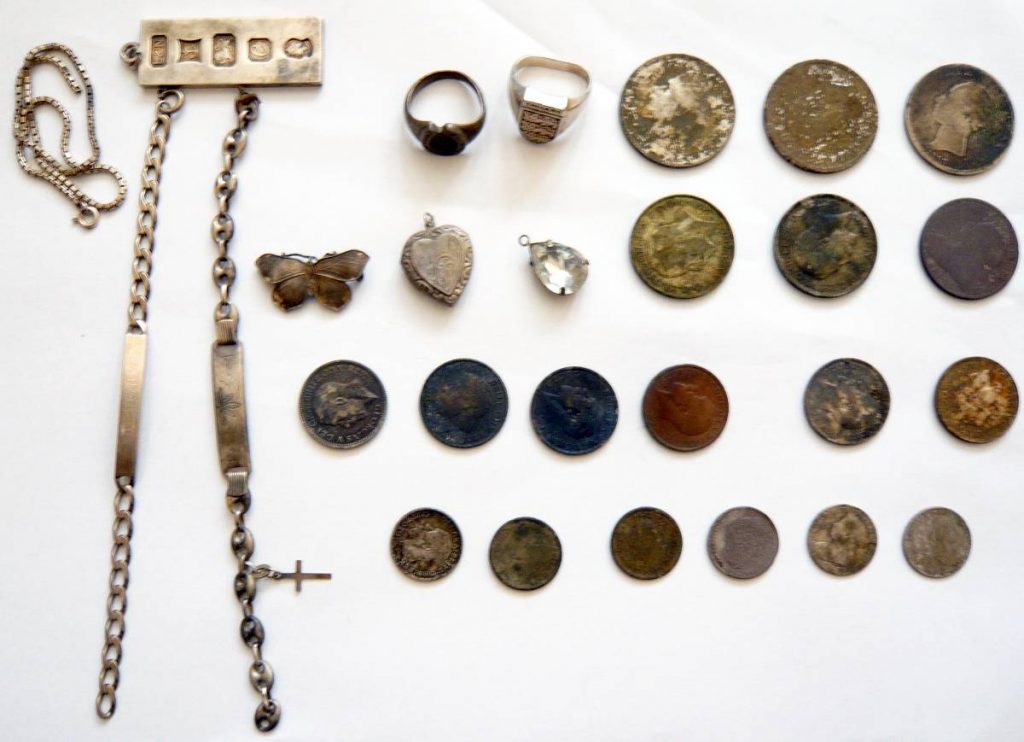
Random Metal Detecting Finds
I’ve included some trash items in this photo. There were lots more bits and pieces found on this metal detecting day which are now in the recycle bin!
- The locket is gilt plated but didn’t have a photo or such inside, which is a pity.
- A small metal gun (it still cocks and fires)
- Two badges. The triangular milk badge say’s ‘Safety First’ down the sides and ‘Milk’ along the bottom, the Bumble Bee Badge is more interesting, it has ‘Lords’ across the top and ‘Finis Coronet Opus‘ around the bottom which roughly means ‘The End Crowns The Work’ – a nice find.
- The small car is just junk, it has no detail on the underside except ‘Made in China’.
- In the junk there were the usual illumination bulb screw fittings.
Anyhow, here are the finds for the day:

Read the Beach to make your Metal Detecting Effective
James also says “I cannot stress enough the importance of trying to locate the areas which have most potential. The beach seems to be the size of the Sahara desert. So you could use your metal detector for an entire session without finding a thing or even getting one signal. This has happened to me a couple of times, when extra sand had been deposited on the beach and not even any rubbish was present!
“It’s all part of the learning curve but in my early days of beach detecting, it was soul-destroying. I didn’t recognise the beach as well as I should. I just detected anywhere!
“Even with experience and careful thought, finds are still hard to come by. I have to work hard for them most of the time. When I chat to other detectorists they agree that Blackpool beach is tough. Don’t beat yourself up if on some occasions you don’t find much! Above all, enjoy your hobby, and enjoy the great outdoors.”
Lost Villages
It’s strongly indicated that in 1532 where South Blackpool is now, the sea rapidly surged inland for some distance. The village of Waddam Thorpe was destroyed and there’s no record of any survivors. After some time the sea finally receded to the coast line we’re used to today.
A similar thing is said to have happened at Cleveleys in 1555, though the records are not clear. The sea is said to have surged upon the land destroying the village of Singleton Thorpe. But unlike at Waddam Thorpe, most of the villagers escaped. It’s been suggested that the “villages” were no more than a farm or two and that’s why hard evidence is difficult to find. There is also rumour of a series of violent storms happening at this time.
Petrified Forest
What is for sure is that just about half way between the low and high water mark, out from present day Cleveleys, there was once a forest. Only the petrified stumps remain, visible now at very low water.
Sand movements may cover or uncover these remains, depending on tides and weather. A big tide with gale force winds will more likely move sand on the beach and expose the trunks.
While you’re here…
Have a look at the homepage of the Visit Fylde Coast website for more of the latest updates.
Love the Fylde Coast? Sign up for your weekly email newsletter. Packed full of interesting things it arrives in your inbox all 52 weeks of the year.
Join us on Facebook at our Visit Fylde Coast Facebook Group
Don’t forget to follow us on Twitter @visitFyldeCoast


