If you love to walk on the beach you’ve probably picked up these twinkling little seaside gems. But have you ever stopped to wonder more about it? We’ve been finding out about glass on beach – to help in your hunting! Here’s all about sea glass…
What is Sea Glass?
It’s ordinary glass which has been physically and chemically weathered by the sea and the shore to create a naturally frosted glass. It can take anything from 20-40 years to form and some of it could have been in the sea 100-200 years! The broken pieces are tumbled and rumbled by the action of the tide, waves, sand and beach material. It’s like a slow version of the tumbling machines that are used to make polished jewellery stones.
Most of it will sink in the sea, which means that most of what we pick up has been dropped near the shore. It’s more common in some areas than it is in others. North West England is famous for it and there are some great hunting spots right here on the Fylde Coast.
How to Find Glass on Beach
Searching out these little gems isn’t like looking for driftwood. They’re not immediately obvious and they’re not everywhere that you look!
It’s a game of patience. As they say “seek and ye shall find”! Sea glass hunting is a lovely, slow pass-time. When you need to de-stress, slow down and ground yourself, go out onto the beach and enjoy the experience.
Sea glass is generally becoming harder to find. More people collect it and there’s less of it as more plastic is used instead. We went out for a walk on the beach to give you some tips –

Best times to find it
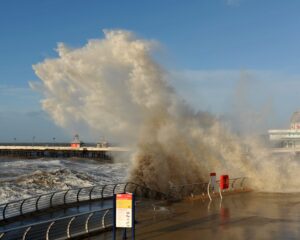
Rough, windy weather creates more waves and agitates the sea and sea bed. In turn this drags up all kinds of things which are later dropped on beaches by retreating tides. So the best time to go out hunting is after Spring Tides and storms. You might be amazed at what else you find – and probably plenty of litter too!
Not all who wander are lost. Some are looking for sea glass.
Best places to find that Glass on Beach
You need to look for a beach with a natural strandline when the tide comes in. Here, the waves travel as far as they can before running out of energy and retreating. It means what they carry gets dropped on the beach – pushed along by the edge of the wave.
Where a beach is completely covered by water at high tide, far less material (of any kind) is left behind. The deep water against the sea wall washes anything it’s carrying back out to sea.
Here on the Fylde Coast you need to be looking for the shingly beaches that retain a dry area at high tide. So Fleetwood beach and Rossall Beach at Cleveleys are two good spots.
Once you’re at the right beach, where are you most likely to find it? Well keep your eyes open as bits can pop up anywhere. But the best hunting grounds are the bands of finer grit. These small stones seem to sieve out the glass and you’ll see them gleaming back at you!

Where the Glass on Beach Comes From
You’ll pick up all sorts of shapes, colours and sizes. Which is your favourite? You’ll also be able to tell what some of it was originally. Some pieces will retain the shape or markings or bottle bottoms and tops. If you’re really lucky you might find a bottle stopper (like the top photo) or a marble.
Much of this broken glass is originally from bottles and tableware. Apparently there’s loads of it offshore with a lot hidden on shipwrecks.
There’s a surprising number of shipwrecks off the Fylde Coast too – all listed on the Shipwreck Memorial. So that explains some of the rarer finds! These old vessels break up during storm conditions and bits of their hoard are released… there’s treasure on them shores!
Did you know? Beach glass is from freshwater, found in rivers and lakes. It usually has a different ph value and is less frosted.
A Big Rubbish Dump
Sadly, the sea has been a dumping ground for hundreds of years. In some parts of the world it still is. Some countries still barge their rubbish out to sea and dump it there.
The Great Pacific Garbage Patch was only discovered in 1997. But today it covers an estimated surface area of 1.6 million square kilometers between Hawaii and California. That’s an area twice the size of Texas, or three times the size of France. It’s a vortex or gyre of marine rubbish. All swirled round into a huge, deep dump. So it’s no surprise that glass – and litter – washes to shore like it does, all over the world.
Different Types of Sea Glass
Some colours and types are more common than others. Here are some of the types you might find:
Most Common
You’re most likely to find green, brown, white and clear glass – originally from bottles. Clear glass is often from glasses, windshields, windows etc.

Rarer
Have you ever found a piece of jade, amber or lime green coloured glass? They most likely started out life as 1960’s soda bottles.
Uncommon
A certain shade of green from the early to mid 1900’s – which were originally Cola bottles.
Very Rare
The exotic colours really are small treasures that you’re unlikely to find. Purple, citron, teal, yellow, red, black and orange. These are very old colours – and could have once been anything!

Features to Look For
- Smooth pieces – well tumbled in an active environment
- Sharp bits – these haven’t moved about so much, but could still be old
- Marbles – once used as ballast and discarded into the water in exchange for cargo
- Rims, threads and curved pieces – come from old bottles
- Vintage bottle glass – has lip and rim lines
- Raised lettering is always a nice find!
- Inkwells, tableware and fiesta-ware pottery from the 1930’s
- Bonfire glass – formed from burning rubbish
- Bubbles – show that glass is older and pre-dates 1920
- Have you ever found a sea glass bead? They’re very rare and predate the 1900’s.
We’ve got our own, quite large collection of finds. Have a look through our stash with us and see what’s hiding in that big glass bottle!


► You can BUY your own sea glass book here: https://amzn.to/2QpVY86
By following this affiliate link we may earn a small commission from your purchase.
The Sea Glass Community
It’s quite surprising to discover just how big a thing that looking for glass on beach is. There’s a huge, world-wide community of enthusiasts who share their knowledge and compete for the best finds.
The Sea Glass Association is one of these groups, based in North America. More surprisingly, beaches actually exist in some parts of the world, entirely made of naturally deposited sea glass!
Fun for Free!
Let’s face it, life is expensive and most things cost money. But there are loads of ways to enjoy your free time without spending a fortune! Looking for sea glass is just one fun thing to do that’s free. It also gets you outside in the fresh air, exercise and some amazing views, close to nature. Check out our other ideas for things to do for free, here
While you’re there you can enjoy the sounds of the sea – waves, seagulls and the tinkling noise of the sea on the pebbles. Follow the link and you’ll find a playlist of waves!
And if you’re really lucky, on rare days in winter you might even get to see snow on the beach. All of the salt in the atmosphere tends to stop it from settling so much. But once in a while the beach gets carpeted in white…
While you’re here…
Go to the homepage of the Visit Fylde Coast website for the latest updates.
Love the Fylde Coast? Sign up for your email newsletter. Packed full of interesting things it arrives in your inbox all 52 weeks of the year.
👉Join us on Facebook at our Visit Fylde Coast Facebook Group. Plus hundreds of videos to watch on our YouTube channel – from all over the Fylde Coast!
📣JOIN our new VFC WhatsApp Channel for what’s happening, interesting local information, history, communities, events and much more.
Booking a stay? Pick a safe, clean and legal place to stay, at the very best price. Book using the Visit Fylde Coast Accommodation guide.