


Back in 2018, the Marine Conservation Society were warning beach visitors in the south not to touch this bizarre stinging creature. It’s rare but they do sometimes appear here. Have you ever seen a Portuguese Man o’War here in the north west?
Reports in 2018 only sighted them in SW England. But back in 2009 they were reported from the Isle of Man to the Isle of Wight and all counties in between. So if there’s a significant influx you might see them here on the Fylde Coast – so please keep your eyes peeled and report any that you encounter.
What is a Portuguese Man o’War?
The Portuguese Man o’ War isn’t a jellyfish but is closely related. It consists of a floating colony of hydrozoans – several tiny marine organisms living together and behaving collectively as if one animal. A purple float, shaped a little like a Cornish pasty, is visible on the water’s surface. Blue, tentacle-like ‘fishing polyps’ hang below – these can be tens of metres in length.
It’s the tentacle-like polyps that can give an agonising and potentially lethal sting. A stranded Portuguese Man o’ war looks a bit like a deflating purple balloon with blue ribbons attached. It looks quite fascinating, washed up on a beach. If you’re visiting west coast beaches it’s well worth making sure you know what these animals look like and that no one picks them up.
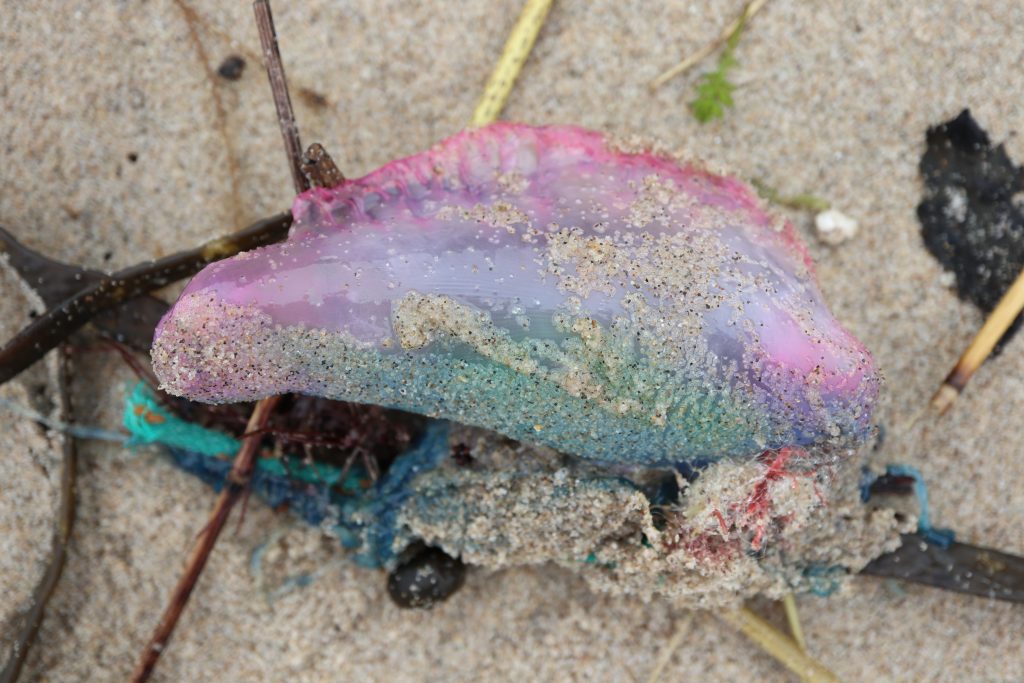
The stings can be unbelievably painful and in rare cases, fatal.
The Marine Conservation Society asks that you report any sightings of Portuguese man o’war to their website. That way they can get a better idea of where they’re visiting UK waters and stranding.
Spotted a Portuguese man o’war? Please report the sighting immediately, ideally with a picture. You can also download a Jellyfish ID Guide, which includes the Portuguese man o’war.
- Report your sighting to www.mcsuk.org
And of course, don’t forget to send a copy of your photo to Visit Fylde Coast too! Email to jane@theRabbitPatch.co.uk
Our beach cleaning colleagues Friends of Portheras Cove in North Cornwall have seen them washed up. Here’s one of the specimens they found –
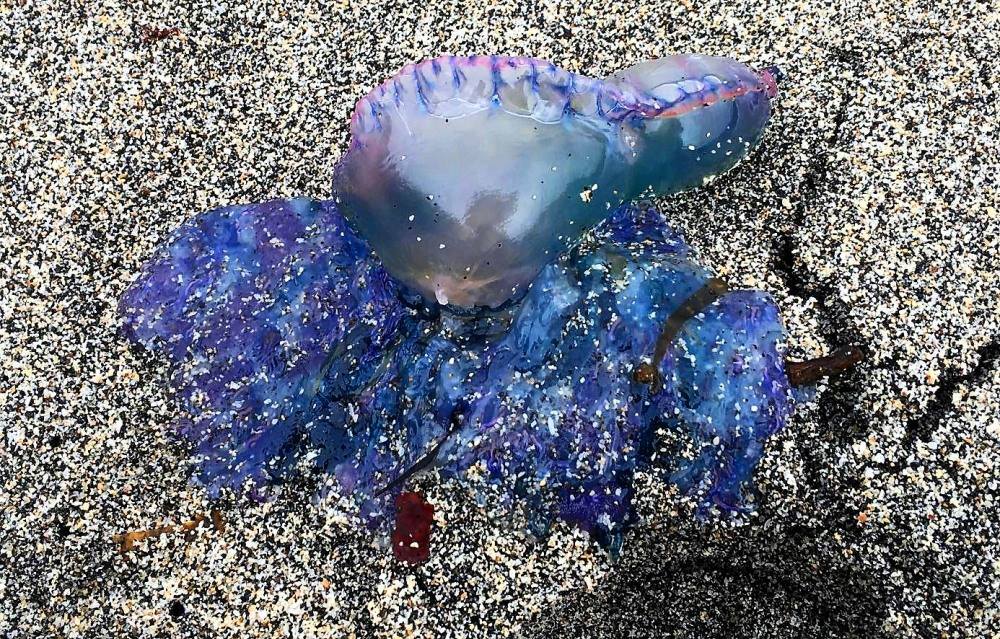
Look – but don’t touch!
It’s best not to touch these stinging jellyfish-like creatures if you do come across them.
In 2018, the Marine Conservation Society received several reports in a week of them washing up on beaches in Cornwall. Perranporth beach in north Cornwall was temporary closed as a precaution due to the number of specimens found. They were also reported in Ireland.

Dr Peter Richardson is Head of Ocean Recovery at MCS. He says: “Portuguese man o’war are ocean-going animals. Propelled by the wind on their inflatable sail, they fish the depths with their stinging tentacles. Persistent winds can blow them from the Atlantic onto our shores”.
Portuguese man o’war (Physalia physalis) are only occasionally reported in UK waters. This was the second consecutive year they’d turned up in numbers. In 2017 they were spotted in September on beaches in the South West UK. Significant strandings were also reported in in 2009 and 2012.
While you’re here…
Have a look at the homepage of the Visit Fylde Coast website for more of the latest updates.
Love the Fylde Coast? Sign up for your weekly email newsletter. Packed full of interesting things it arrives in your inbox all 52 weeks of the year.
Join us on Facebook at our Visit Fylde Coast Facebook Group
Don’t forget to follow us on Twitter @visitFyldeCoast


