

Since we’re all obsessed with coronavirus, I’d been thinking that the current problem is very similar to how illness was dealt with when I was young. And about the old fashioned remedies we all used.
Just quickly, while we’re on the subject, I can’t help but think that the crowds of people on the prom everyday aren’t in the same world that I am. On Tuesday and Wednesday this week it’s been standing room only for cars on the prom, if you get me. Obviously cars can’t stand on end but I mean it’s a full place!
People are milling about, not observing the rules, and a lot aren’t distancing themselves. Why I don’t know. We keep watching people standing chatting etc. so I can only assume that they are deaf or don’t watch TV. This comes after the police made an appeal on Facebook about our prom being so busy.
Either haven’t read it, or just don’t care. We wouldn’t go out if we wanted to as there are too many people clumping together on the narrow prom. I personally haven’t been any further than our front gate and don’t intend to, as I would be the dope that caught the virus and gave my lot it! Going on five weeks I’ve kept this up now, and I’m not going anywhere until I know it is very, very safe to do so. You know what they say, it’s better to be safe than sorry!!
Old Fashioned Remedies
Anyway, back to the main subject. I was thinking the other day about how things would have been so different in the 1918-20 Spanish flu virus with today’s knowledge. It killed at least 50 million people worldwide. They had none of the modern day things to help lessen the impact such as PPE. It probably hadn’t been even thought about back then. Medicines weren’t advanced and respirators and the like would hardly have been heard of.
I don’t know whether you’ve already seen it, but there’s a programme on iPlayer called ‘The Flu that Killed 50 Million‘. It’s well worth a watch if you haven’t. It makes sense of what we’re going through – and what will happen if we don’t control coronavirus.

It all made me think about how few things there were to help us to recover from a wide variety of illnesses. You only went to the doctors if you were dying on your feet. To have the doctor come out to you would have to be a matter of life or death. As a result, people used old fashioned remedies that had been passed down through the generations. And they always seemed to work!
Old Fashioned Remedies for Headaches…
When I was a child, if I had a headache, my mum would have me lie down and put a vinegar cloth on my forehead.
A vinegar cloth was a flannel dunked into a bowl of vinegar, wrung out and then put on your head. Don’t ask me why, but it always worked, although I did rather smell like the local fish shop!
Of course, we never had headache tablets in the house. I don’t even know if there were such drugs in those days other than aspirin. But the whole medical treatment was archaic when you looked back.
For a Cough…
Good old Vic vapour was used back then too, so that’s been going for some years hasn’t it.
If I had a bad cough, when I went to bed my mum would rub Vic on the front and back of my chest. Some more went on my throat and a bit up my nose to help me breathe. Then of course, on went my liberty bodice to keep it all warm.
For those of you who are younger than me, a liberty bodice was a sort of vest, with the most lovely, warm, almost fleece-like inside that went next to your skin. I had to wear them every Winter.

They were made by Cherub and had this cute label on when you got a new one, with a pretty pink cherub on which I thought was lovely.
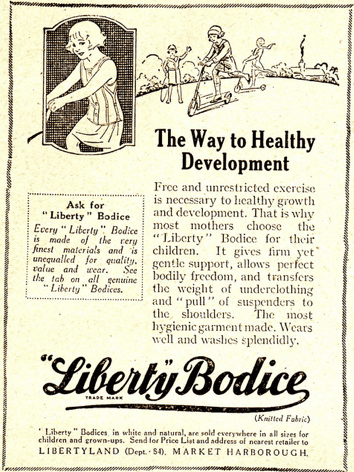
I didn’t see the cherub very often though as I only got a new one when the old one had become too small for me and just about worn away. There was no ‘wear something a few times and then throw it away’ back then. Most people didn’t have disposable cash and you had to make your money go as far as it would, to make ends meet.
Old Fashioned Remedies for a really Bad Chest…
I remember when I had a particularly bad chest and was ill in bed, my mum making a kaolin poultice to put on my chest, back and front.
What was in the poultice that made it work I’m not sure, other than it had to be red hot when you applied it, to get the heat to your chest. So what exactly was in it other the kaolin I don’t know.
I do know that it didn’t smell sweet and was red hot. It always seemed to make me better though!
Boils
Another use in the old days for the kaolin poultice was to ‘draw’ boils and suchlike.
If you applied it as hot as you could stand, it would bring a painful infected boil or some other ailment to the surface of your skin. It always made it better.
And the Runs…
Now I did know one use for kaolin when I was growing up. It was what you took if you had the runs!
Do or Die
Then of course there was the tried and tested ‘do or die’ method, where you either got better or you didn’t.
My mum caught diphtheria when she was a young girl.
A sore throat turned into the whole of your throat swelling up and suffocating you, with a membrane that went across your throat. Not a disease to be caught, or else. My mum was very lucky to survive as there were no cures for it then. You got better or you didn’t.
That was the same with many of the illnesses and diseases that we expect to be cured today. Your own immunity fought it off or it didn’t. Remember that antibiotics were only coming into ordinary use by the late 1940’s, and were still ‘special’ at the time.
If you caught a contagious disease you went to one of the old fashioned isolation hospitals that I wrote about a couple of weeks ago. My dad went in one for ages when he caught Scarlet Fever.
There were loads of old remedies, too many to write here but they always seemed to work. Maybe they still would today, instead of putting all these drugs into our bodies without knowing what effect they can have on us!
You might also enjoy:
While you’re here…
Join me on social media – www.Facebook.com/ChrissieBlogger and @ChrissiesBlog
See the homepage of the Visit Fylde Coast website for more of the latest updates.
Love the Fylde Coast? Sign up for your weekly email newsletter. Packed full of interesting things it arrives in your inbox all 52 weeks of the year.
Join the Visit Fylde Coast Facebook Group and you can follow us on Twitter @visitFyldeCoast


